Explanation
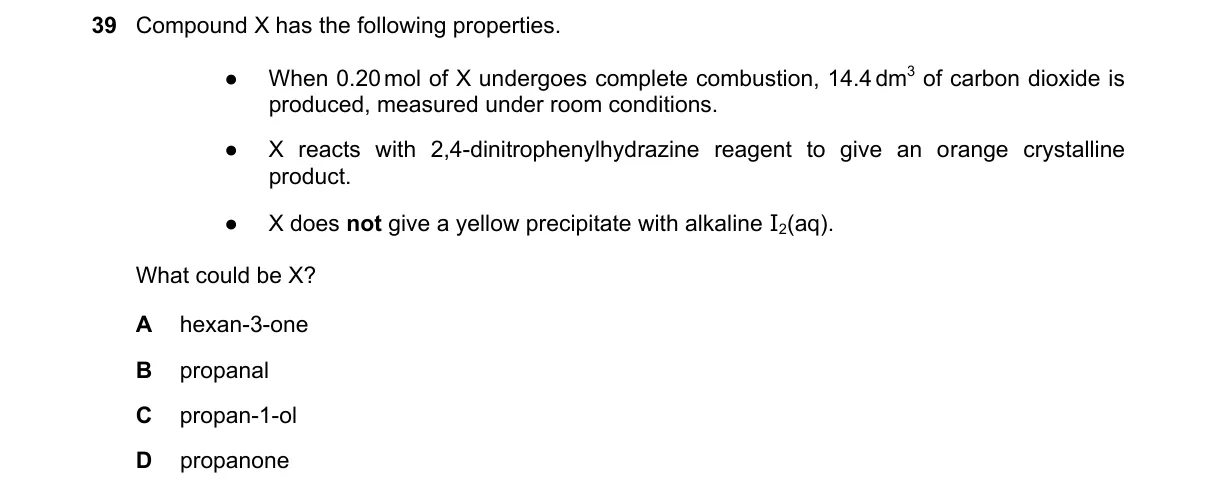
Chemical tests and combustion analysis identify X as a non-methyl ketone with 6 carbons Steps: - Combustion produces 14.4 mol CO2 from 2.0 mol X, so 14.4 / 2 = 7.2 mol CO2 per mol X, indicating approximately 6 carbon atoms (matches C6 options A and B; C3 options give only 6 mol CO2 total). - Positive reaction with 2,4-DNPH (orange product) confirms X contains a carbonyl group (aldehyde or ketone), eliminating alcohols B and C. - Negative iodoform test (no yellow CHI3 precipitate) rules out methyl ketones like propanone (D) or acetaldehyde. - Thus, X is hexan-3-one (A), a C6 ketone without CH3CO- group. Why A is correct: - Hexan-3-one (CH3CH2COCH2CH2CH3) has a carbonyl for DNPH reaction, no methyl ketone structure for iodoform, and formula C6H12O yields 6 mol CO2 per mol (12 mol from 2 mol, consistent with data). Why the others are wrong: - B. Hexan-1-ol lacks carbonyl, fails DNPH test. - C. Propan-1-ol has 3 carbons, yields only 6 mol CO2 from 2 mol; lacks carbonyl. - D. Propanone is methyl ketone (CH3COCH3), gives iodoform precipitate. …
Practice more A Levels Chemistry (9701) questions on mMCQ.me