A Levels Chemistry (9701)•9701/13/M/J/24
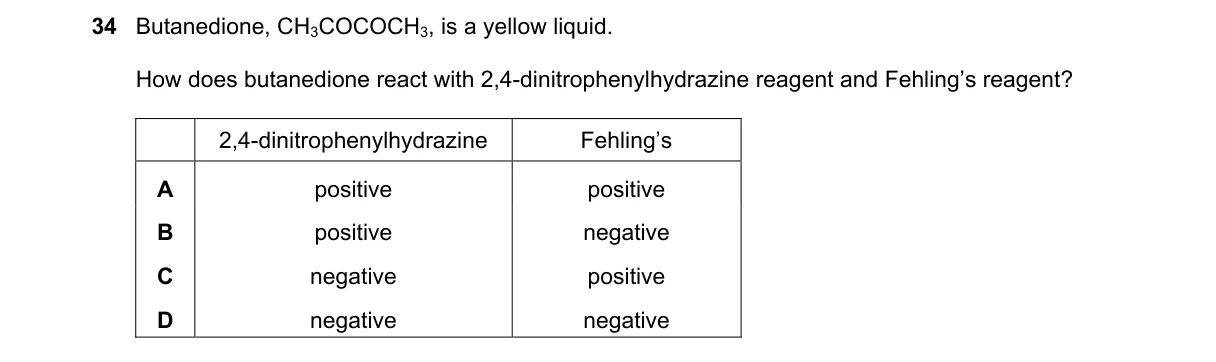
Explanation
Butanedione's reactivity as a 1,2-diketone Steps:
- Butanedione is butane-2,3-dione, with formula CH₃C(O)C(O)CH₃, containing two adjacent ketone groups.
- 2,4-Dinitrophenylhydrazine (DNPH) reacts with any carbonyl (aldehyde or ketone) to form a yellow-orange hydrazone precipitate, so positive test.
- Fehling's reagent oxidizes aldehydes or alpha-hydroxy ketones but not simple ketones or 1,2-diketones, so no reduction and negative test.
- Thus, the reaction profile is positive for DNPH and negative for Fehling's.
Why A is correct:
- 1,2-Diketones like butanedione have carbonyls that form hydrazones with DNPH (positive) but lack the aldehydic H or enolizable structure for Fehling's reduction (negative).
Why the others are wrong:
- B: DNPH test is positive for ketones, not negative.
- C: Fehling's test is negative for non-reducing diketones, not positive.
- D: DNPH test is positive due to carbonyl presence, not negative.
Final answer: A
Topic: Carbonyl compounds
Practice more A Levels Chemistry (9701) questions on mMCQ.me