A Levels Chemistry (9701)•9701/12/M/J/24
Explanation
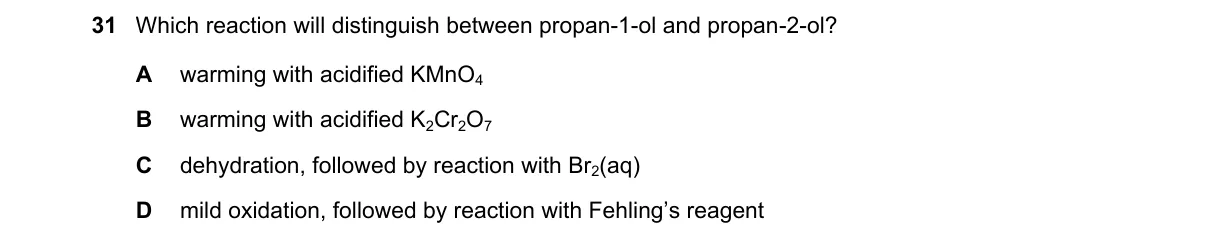
Distinguishing primary vs. secondary alcohols by oxidation to aldehyde vs. ketone
Steps:
- Propan-1-ol (primary) undergoes mild oxidation to propanal (aldehyde).
- Propan-2-ol (secondary) undergoes mild oxidation to propanone (ketone).
- Fehling's reagent reacts with aldehydes to give a red precipitate but not with ketones.
- Thus, only propan-1-ol shows a positive Fehling's test after mild oxidation.
Why D is correct:
- Primary alcohols oxidize to aldehydes (RCH2OH → RCHO), which reduce Fehling's to Cu2O (red ppt); secondary alcohols form ketones (R2CHOH → R2C=O), which do not react.
Why the others are wrong:
- A: Both alcohols decolorize acidified KMnO4 via oxidation to carbonyl compounds.
- B: Dehydration of both yields propene, which adds Br2 to form dibromopropane.
- C: Both alcohols are oxidized by acidified K2Cr2O7 (primary to acid, secondary to ketone), with similar color changes.
Final answer: D
Topic: Hydroxy compounds
Practice more A Levels Chemistry (9701) questions on mMCQ.me