Explanation
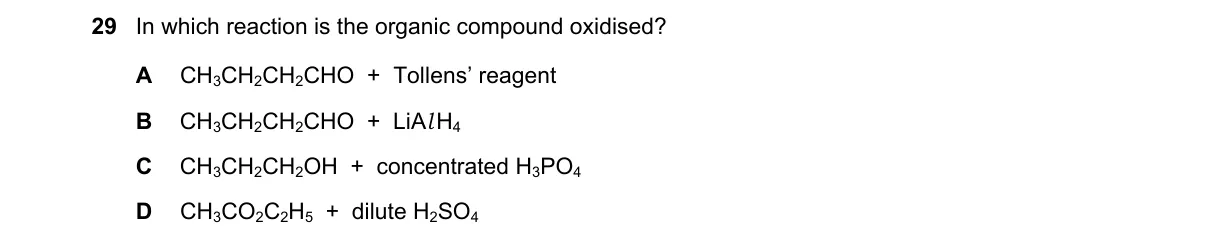
Oxidation of primary alcohols by Tollens' reagent Steps: - Identify organic compounds: A (propan-1-ol, primary alcohol), B (propanal, aldehyde), C (ethanol, primary alcohol), D (ethanoic acid, carboxylic acid). - Recall oxidation in organics: loss of hydrogen or gain of oxygen, converting alcohols/aldehydes to higher oxidation states like carbonyls or acids. - Analyze reactions: Tollens' reagent (ammoniacal AgNO3) oxidizes aldehydes to carboxylic acids and primary alcohols to aldehydes/acids; conc. H2SO4 dehydrates alcohols; dil. H2SO4 with carboxylic acid yields no oxidation. - Select option where starting compound loses electrons/increases oxidation state: A shows alcohol to carbonyl oxidation. Why A is correct: - Propan-1-ol (primary alcohol) is oxidized by Tollens' reagent to propanal then propanoic acid, forming silver mirror as byproduct (standard mild oxidation test). Why the others are wrong: - B: Propanal (already oxidized aldehyde) reacts with Tollens' but starts as oxidized form; no further organic oxidation emphasized. - C: Ethanol undergoes dehydration with conc. H2SO4 to ethene, an elimination reaction, not oxidation. - D: Ethanoic acid with dil. H2SO4 shows no reaction or possible esterification (if alcohol added), but carboxylic acid …
Practice more A Levels Chemistry (9701) questions on mMCQ.me