A Levels Chemistry (9701)•9701/11/M/J/24
Explanation
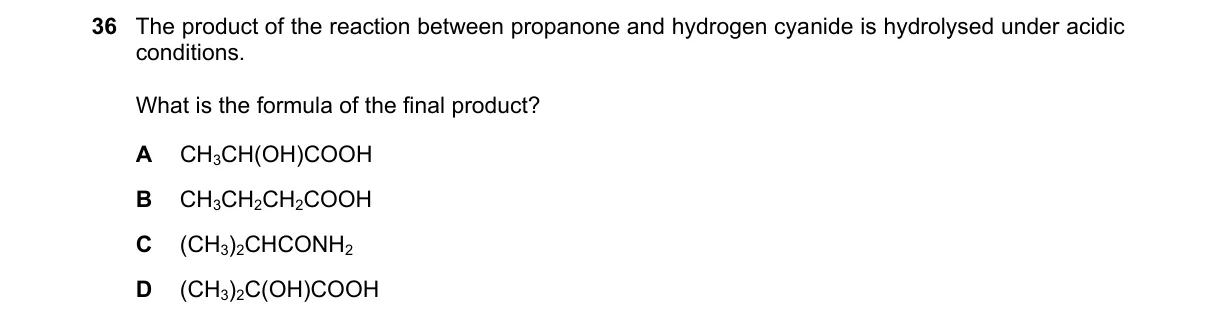
Cyanohydrin formation and nitrile hydrolysis extend the carbon chain to a branched carboxylic acid
Steps:
- Propanone ((CH3)2C=O) adds HCN across the carbonyl to form the cyanohydrin (CH3)2C(OH)CN.
- The -CN group undergoes acidic hydrolysis (H3O+, heat) to -COOH.
- This replaces the carbonyl oxygen with -CH(CN) effectively, but hydrolysis yields the extended chain (CH3)2CHCOOH.
- The reaction increases the carbon count by one, forming 2-methylpropanoic acid.
Why D is correct:
- Nitrile hydrolysis under acidic conditions converts -CN to -COOH, extending propanone's chain to the branched C4 acid (CH3)2CHCOOH per standard organic transformation.
Why the others are wrong:
- A: Product from propanal (aldehyde) cyanohydrin hydrolysis, not propanone.
- B: Propanoic acid from propanone oxidation, no chain extension.
- C: Isopropanol from propanone reduction, no HCN involvement.
Final answer: D
Topic: Carbonyl compounds
Practice more A Levels Chemistry (9701) questions on mMCQ.me