A Levels Chemistry (9701)•9701/11/M/J/24
Explanation
Conflicting test results make identification ambiguous
Steps:
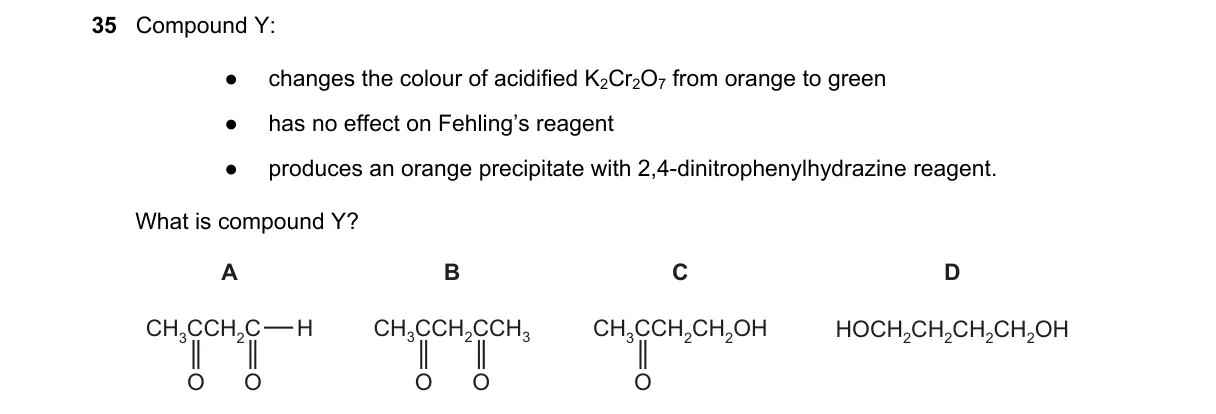
- No effect on Fehling's reagent eliminates aldehydes (A) and reducing groups, pointing to non-reducing compounds like ketones or alcohols.
- Color change of acidified K₂Cr₂O₇ to green indicates oxidation to Cr³⁺, typical for primary/secondary alcohols (C, D) or aldehydes (A).
- Orange precipitate with 2,4-DNPH confirms a carbonyl group (aldehyde or ketone, A or B).
- The tests conflict: carbonyl required for DNPH but alcohols (C, D) lack carbonyls, while ketone (B) resists dichromate oxidation.
Not enough information to uniquely identify compound Y, as no option matches all three tests.
Final answer: Not enough information.
Topic: Carbonyl compounds
Practice more A Levels Chemistry (9701) questions on mMCQ.me