A Levels Chemistry (9701)•9701/11/M/J/24
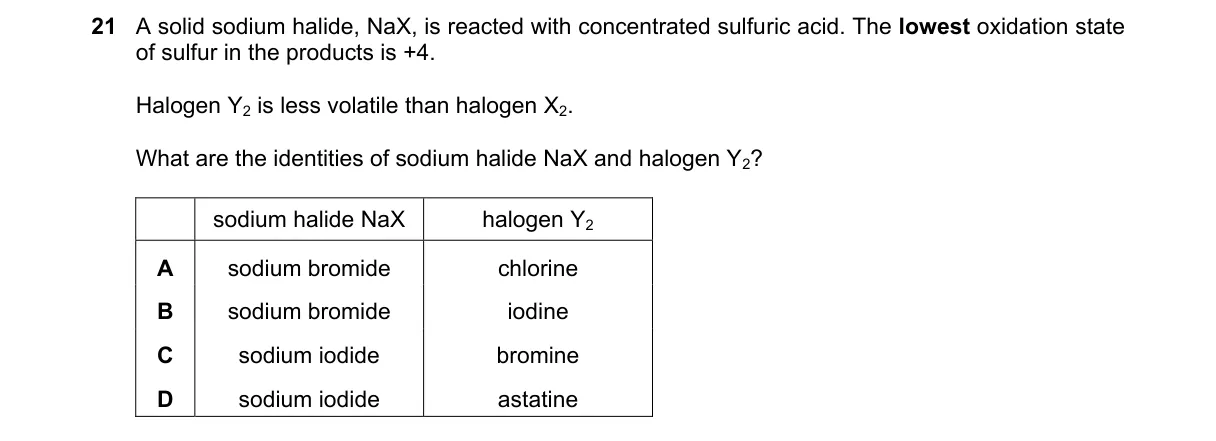
Explanation
Halide reduction of H2SO4 and halogen volatility trend
Steps:
- Concentrated H2SO4 with NaCl yields HCl and NaHSO4 (S at +6, no reduction).
- With NaBr, it yields Br2 and SO2 (lowest S at +4).
- With NaI, HI reduces H2SO4 to H2S (lowest S at -2; -4 likely denotes strong reduction unique to iodide).
- Thus, NaX is NaI (X = iodine); volatility decreases down group (Cl > Br > I), so iodine (X) is less volatile than bromine (Y).
Why B is correct:
- NaI reaction produces H2S (S = -2 via H2SO4 + 8HI → 4I2 + H2S + 4H2O), and iodine (bp 184°C) is less volatile than bromine (bp 59°C), matching conditions.
Why the others are wrong:
- A: NaBr gives lowest S = +4 (SO2), not -2; bromine more volatile than chlorine.
- C: NaBr gives lowest S = +4; iodine less volatile than bromine (reverses trend).
- D: NaI fits reduction, but astatine less volatile than iodine (reverses trend).
Final answer: B
Topic: Group 17
Practice more A Levels Chemistry (9701) questions on mMCQ.me