A Levels Chemistry (9701)•9701/13/M/J/23
Explanation
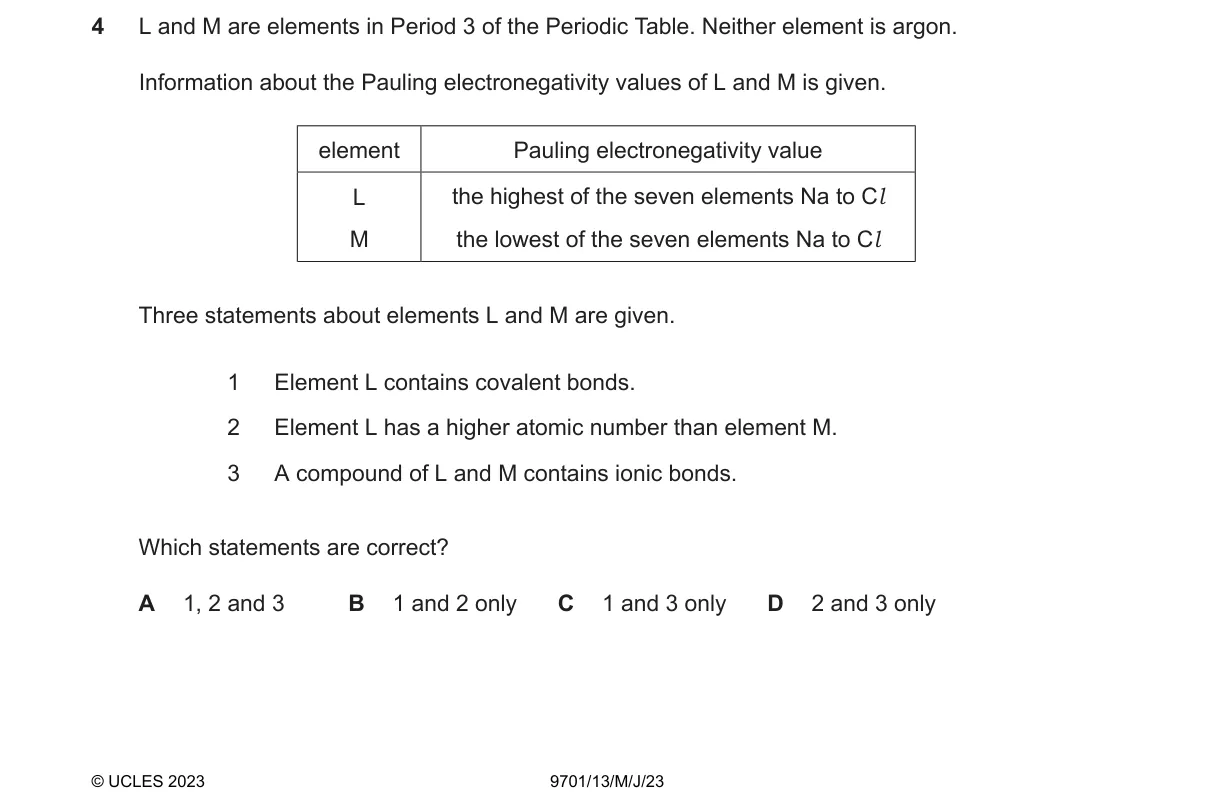
L is chlorine; M precedes it in period 3 Steps:
- L has the highest electronegativity (3.0) among Na (0.9) to Cl, so L is Cl (atomic number 17).
- Statement 1 is correct: Cl forms covalent bonds in Cl₂ molecules.
- Statement 2 is correct: M is one of Na to S (atomic numbers 11–16), so L's atomic number exceeds M's.
- Statement 3 is correct: M, being less electronegative than Cl, is a metal (Na, Mg, or Al) that forms ionic bonds in compounds like NaCl.
Why A is correct:
- All statements hold true based on L's identification as Cl and M's position earlier in period 3, per periodic trends where left-side elements form ionic bonds.
Why the others are wrong:
- B omits 3, but M forms ionic bonds as a period 3 metal.
- C omits 2, but Cl's atomic number (17) is higher than M's (≤16).
- D omits 1, but Cl contains covalent bonds in its molecular form.
Final answer: A
Topic: The Periodic Table: chemical periodicity
Practice more A Levels Chemistry (9701) questions on mMCQ.me