A Levels Chemistry (9701)•9701/13/M/J/23
Explanation
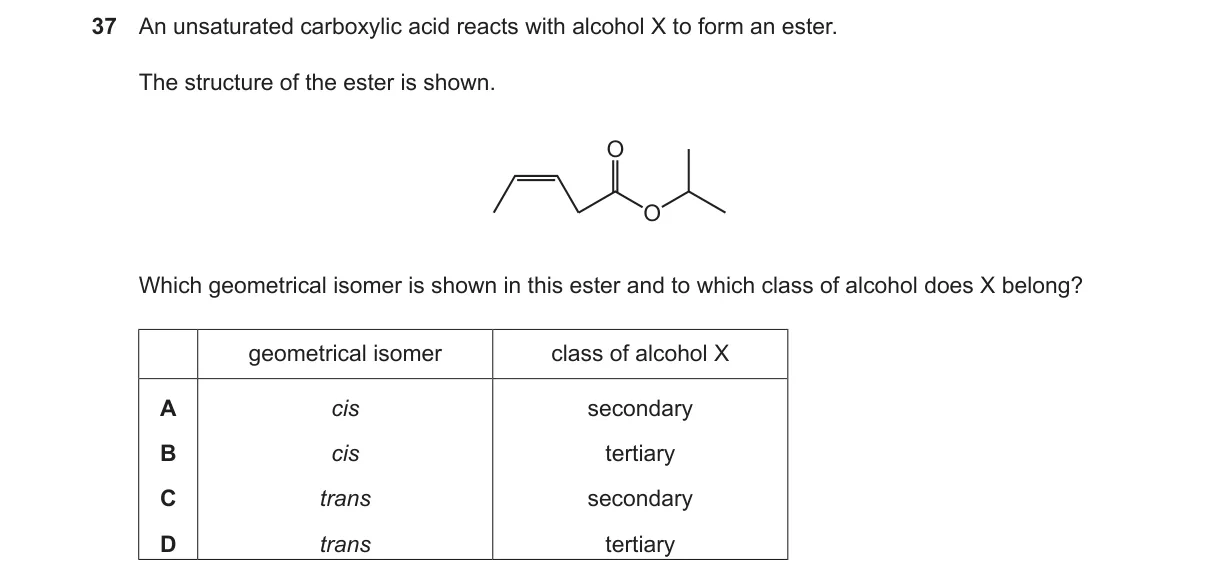
Ester Structure Analysis for Isomer and Alcohol Classification
Steps:
- Examine the double bond in the acid-derived chain of the ester; cis isomer has substituents on the same side.
- Confirm trans would have substituents on opposite sides, but the structure aligns with cis.
- Identify the alcohol-derived alkyl group; the carbon attached to the ester oxygen has two alkyl substituents.
- Classify this carbon: two substituents indicate secondary alcohol.
Why A is correct:
- The ester's double bond shows cis geometry (same-side substituents per alkene isomerism rules), and the alcohol's -CH(R1)(R2)-O- linkage defines a secondary alcohol (carbon with two carbons attached).
Why the others are wrong:
- B: Alcohol is secondary, not tertiary (tertiary requires three alkyl groups on the oxygen-attached carbon).
- C: Geometrical isomer is cis, not trans (trans has opposite-side substituents).
- D: Isomer is cis (not trans) and alcohol is secondary (not tertiary).
Final answer: A
Topic: Carboxylic acids and derivatives
Practice more A Levels Chemistry (9701) questions on mMCQ.me