A Levels Chemistry (9701)•9701/13/M/J/23
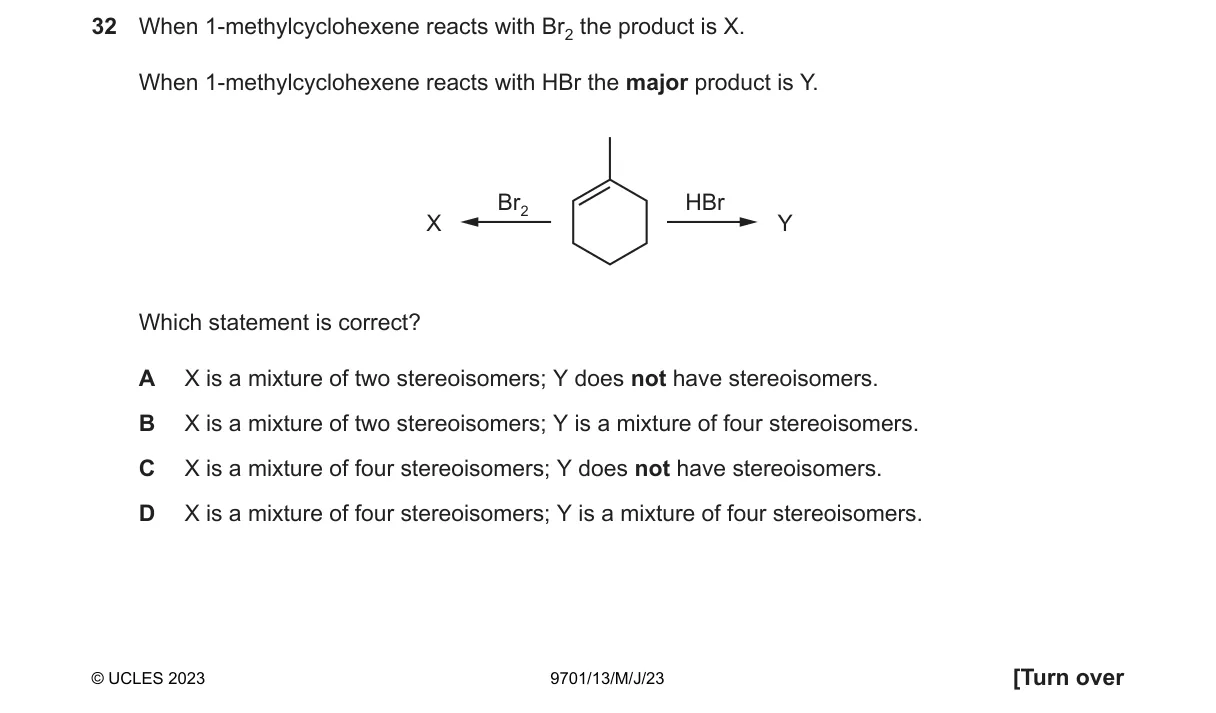
Explanation
Stereoisomers in addition products to 1-methylcyclohexene
Steps:
- Br₂ addition to 1-methylcyclohexene yields 1-bromo-1-methyl-2-bromocyclohexane (X), with chiral centers at C1 (attached to Br, CH₃, -CHBr-, -CH₂-) and C2 (attached to Br, H, -CBr(CH₃)-, -CH₂-).
- Two chiral centers allow 4 stereoisomers (RR, SS, RS, SR).
- HBr addition follows Markovnikov's rule: H adds to C2, Br to C1, yielding 1-bromo-1-methylcyclohexane (Y).
- Y has C1 attached to Br, CH₃, and two identical -CH₂- ring arms, making it achiral with no stereoisomers.
Why C is correct:
- The dibromide X has two distinct chiral centers, so 2² = 4 possible stereoisomers; Y is achiral per symmetry in tertiary alkyl halide.
Why the others are wrong:
- A: Y is achiral, not 4 stereoisomers.
- B: X has 2 chiral centers, allowing 4 stereoisomers total.
- D: Y lacks stereoisomers.
Final answer: C
Topic: Hydrocarbons
Practice more A Levels Chemistry (9701) questions on mMCQ.me