A Levels Chemistry (9701)•9701/12/M/J/23
Explanation
Selective reaction of carbonyl compounds Steps:
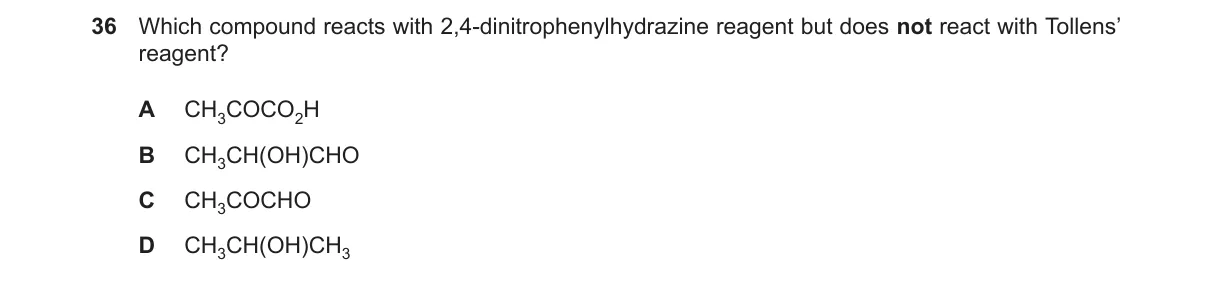
- 2,4-Dinitrophenylhydrazine (DNPH) reacts with aldehydes and ketones via nucleophilic addition to form hydrazones, but not with carboxylic acids or alcohols.
- Tollens' reagent oxidizes aldehydes to carboxylic acids, giving a silver mirror, but does not react with ketones, carboxylic acids, or alcohols.
- Analyze functional groups: A (carboxylic acid), B (aldehyde), C (ketone), D (alcohol).
- Select the compound with a ketone group, which fits both criteria.
Why C is correct:
- CH3COCH3 (acetone) contains a ketone carbonyl (C=O) that forms a hydrazone with DNPH but resists oxidation by Tollens' due to lack of alpha-hydrogen for enolization.
Why the others are wrong:
- A: CH3COOH (carboxylic acid) lacks reactive carbonyl for DNPH hydrazone formation.
- B: CH3CHO (aldehyde) reacts with both DNPH and Tollens' (oxidized to acid).
- D: CH3CH2OH (alcohol) has no carbonyl, so reacts with neither reagent.
Final answer: C
Topic: Carbonyl compounds
Practice more A Levels Chemistry (9701) questions on mMCQ.me