A Levels Chemistry (9701)•9701/12/M/J/23
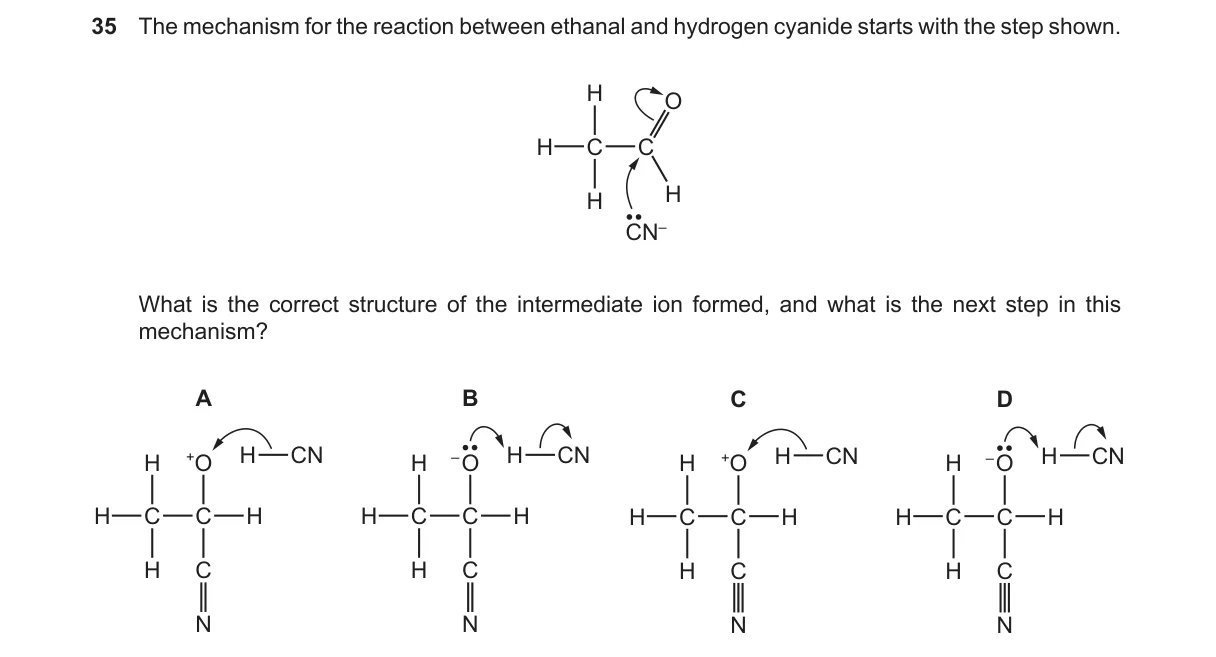
Explanation
Cyanide nucleophilic addition to aldehyde carbonyl
Steps:
- Cyanide ion (CN⁻) attacks the electrophilic carbonyl carbon of the aldehyde (likely ethanal, not ethanol as stated).
- This forms a tetrahedral alkoxide intermediate by breaking the C=O π bond and placing negative charge on oxygen.
- The intermediate ion is R-CH(O⁻)CH₂CN for ethanal.
- Next step: protonation of the alkoxide oxygen by HCN or solvent to yield the neutral cyanohydrin.
Why D is correct:
- D shows the tetrahedral alkoxide ion from CN⁻ addition, matching the standard nucleophilic addition mechanism for cyanohydrin formation.
Why the others are wrong:
- A: Incorrect carbocation structure; addition forms alkoxide, not carbocation.
- B: Wrong regiochemistry; CN attaches to carbonyl carbon, not elsewhere.
- C: Depicts protonated intermediate prematurely; charge is on oxygen post-addition.
Final answer: D
Topic: Hydroxy compounds
Practice more A Levels Chemistry (9701) questions on mMCQ.me