A Levels Chemistry (9701)•9701/12/M/J/23
Explanation
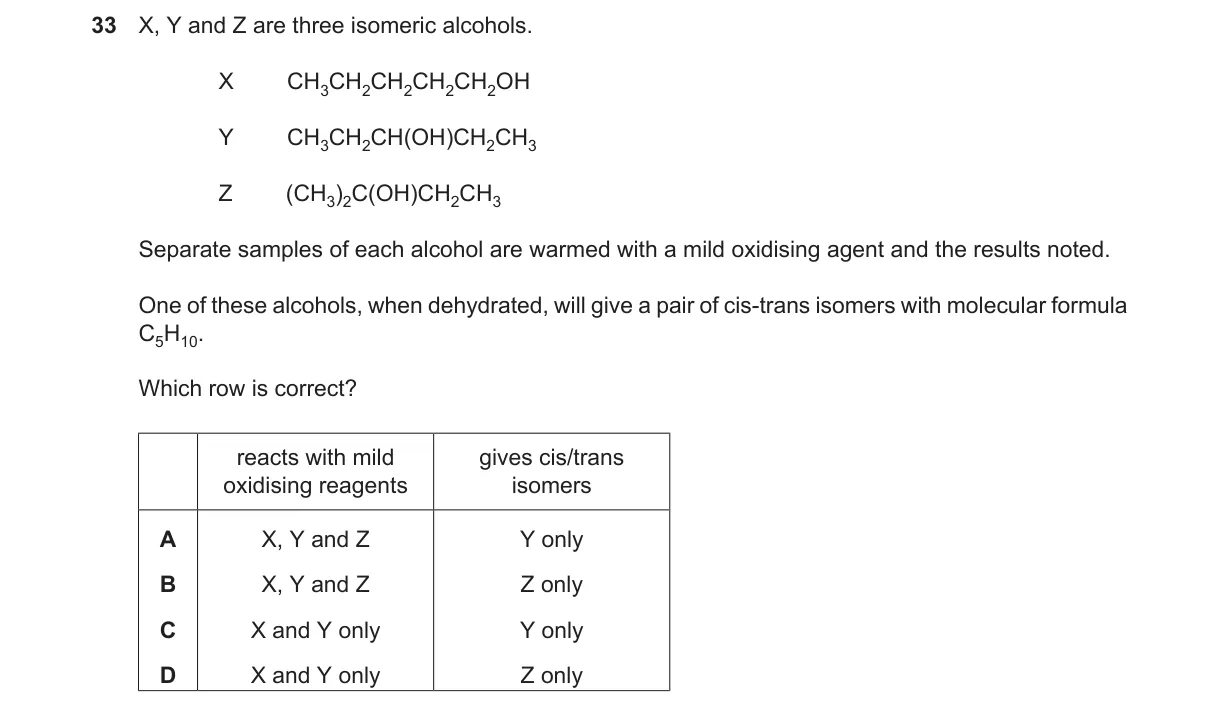
Oxidation and dehydration behaviors of isomeric alcohols Steps:
- Identify alcohol types: X (1-butanol, primary), Y (2-butanol, secondary), Z (tert-butanol, tertiary).
- For mild oxidation: Primary X yields butanal; secondary Y yields butan-2-one; tertiary Z does not react.
- Thus, X and Y oxidize, while Z remains unchanged.
- For dehydration to C₄H₈ alkenes: Y yields mainly cis- and trans-but-2-ene (geometric isomers); X yields mixture including but-1-ene (less emphasis on pair); Z yields 2-methylpropene (no geometric isomers).
Why C is correct:
- Option C matches X and Y oxidizing (per mild agent definition stopping at aldehyde/ketone for 1°/2° alcohols) and Y alone yielding the cis-trans pair (via Zaitsev's rule favoring internal alkene from secondary alcohol).
Why the others are wrong:
- A: Includes Z in oxidation, but tertiary alcohols resist mild oxidation.
- B: Excludes Y from oxidation, but secondary alcohols form ketones.
- D: Assigns dehydration to Z, but 2-methylpropene lacks cis-trans isomerism.
Final answer: C
Topic: Hydroxy compounds
Practice more A Levels Chemistry (9701) questions on mMCQ.me