A Levels Chemistry (9701)•9701/12/M/J/23
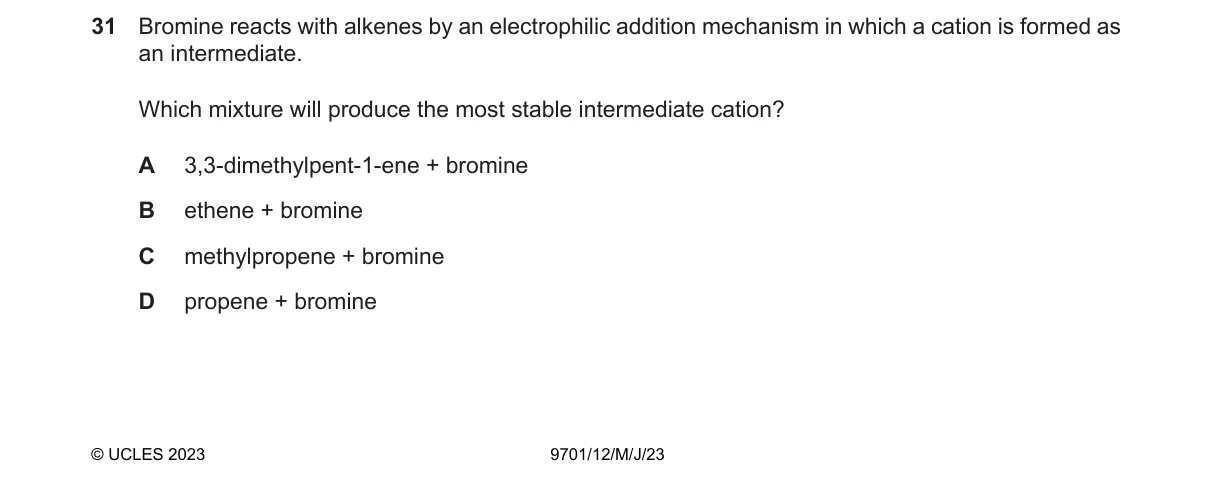
Explanation
Carbocation stability increases with more alkyl substituents
Steps:
- In Br2 addition to alkenes, Br+ adds to the less substituted carbon, placing the positive charge on the more substituted carbon.
- Determine the carbocation type for each alkene: primary (no alkyl groups on + carbon), secondary (one), or tertiary (two).
- Rank stability: tertiary > secondary > primary due to hyperconjugation and inductive effects.
- Identify the alkene yielding the tertiary carbocation as the most stable intermediate.
Why C is correct:
- 2-Methylpropene ((CH3)2C=CH2) forms (CH3)2C+-CH2Br, a tertiary carbocation stabilized by two alkyl groups.
Why the others are wrong:
- A: 3,3-Dimethylbut-1-ene (CH2=CH-C(CH3)2CH3) forms a secondary carbocation (CH2Br-CH+-C(CH3)2CH3).
- B: Ethene (CH2=CH2) forms equivalent primary carbocations (CH2Br-CH2+).
- D: Propene (CH3CH=CH2) forms a secondary carbocation (CH2Br-CH+-CH3).
Final answer: C
Topic: Hydrocarbons
Practice more A Levels Chemistry (9701) questions on mMCQ.me