A Levels Chemistry (9701)•9701/12/M/J/23
Explanation
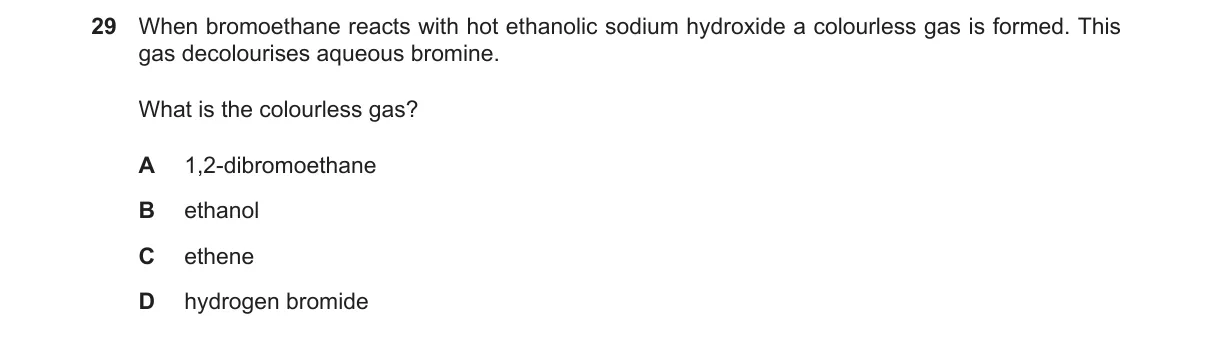
Elimination reaction in hot ethanolic NaOH
Steps:
- Hot ethanolic NaOH favors E2 elimination over substitution for primary alkyl halides like bromoethane (likely intended, as bromomethane lacks beta hydrogens).
- The reaction removes HBr from the alkyl halide: CH3CH2Br + OH⁻ → CH2=CH2 + H2O + Br⁻.
- Ethene (C2H4) forms as the alkene product.
- Ethene is a colorless, gaseous alkene at room temperature.
Why C is correct:
- Ethene is the gaseous product of dehydrohalogenation, matching the colorless gas description per organic elimination mechanisms.
Why the others are wrong:
- A: 1,2-Dibromoethane is a liquid, not a gas, and requires different reactants.
- B: Ethanol is a liquid byproduct in substitution, not elimination.
- D: Hydrogen bromide reacts with NaOH to form NaBr and water, not evolving as a gas.
Final answer: C
Topic: Halogen compounds
Practice more A Levels Chemistry (9701) questions on mMCQ.me