A Levels Chemistry (9701)•9701/11/M/J/23
Explanation
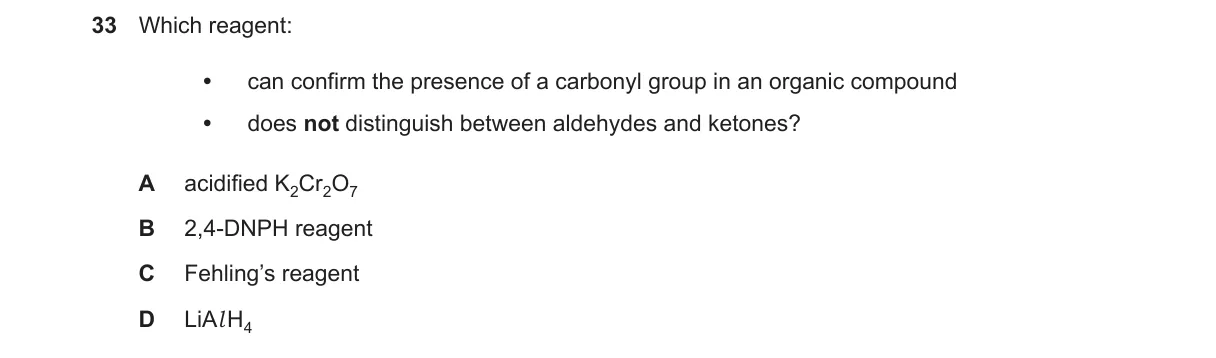
Universal Carbonyl Test Reagent
Steps:
- Identify reagents that react with carbonyl groups (C=O) in aldehydes and ketones.
- Check which form a visible product with both functional groups.
- Eliminate tests specific to aldehydes (reducing sugars or silver mirror).
- Discard non-test reagents used for reduction, not confirmation.
Why A is correct:
- 2,4-Dinitrophenylhydrazine (2,4-DNP) reacts with the carbonyl carbon of both aldehydes and ketones to form a yellow-to-orange hydrazone precipitate, confirming C=O presence without distinguishing the two.
Why the others are wrong:
- B: Fehling's reagent oxidizes only aldehydes (reducing agents), giving a red Cu2O precipitate; ketones do not react.
- C: LiAlH4 reduces carbonyls to alcohols but provides no characteristic test or visible confirmation.
- D: Tollens' reagent forms a silver mirror only with aldehydes; ketones are unreactive.
Final answer: A
Topic: Carbonyl compounds
Practice more A Levels Chemistry (9701) questions on mMCQ.me