A Levels Chemistry (9701)•9701/11/M/J/23
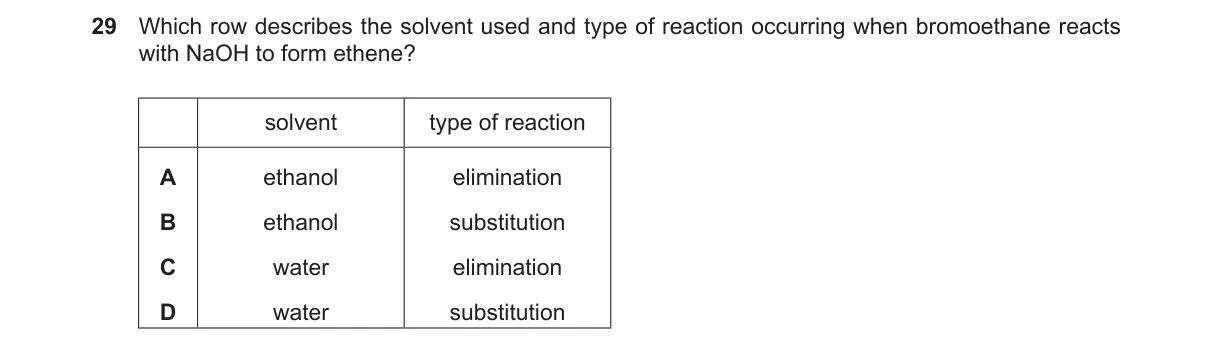
Explanation
Solvent and Reaction Type for Haloalkane to Alkene
Steps:
- Bromoethane (CH3CH2Br) reacts with NaOH to form ethene (CH2=CH2), indicating loss of HBr, which defines an elimination reaction.
- Elimination in haloalkanes requires a strong base like OH- in a non-aqueous solvent to favor dehydrohalogenation over nucleophilic attack.
- NaOH in water acts as a nucleophile, leading to substitution (SN2) to form ethanol (CH3CH2OH), not ethene.
- NaOH in ethanol provides the alcoholic conditions needed for E2 elimination to produce ethene.
Why A is correct:
- Alcoholic NaOH induces E2 elimination: CH3CH2Br + OH- → CH2=CH2 + H2O + Br-, yielding the alkene product.
Why the others are wrong:
- B: Ethanol solvent is correct, but substitution yields CH3CH2OH, not ethene.
- C: Water solvent promotes substitution, not elimination to ethene.
- D: Aqueous NaOH causes SN2 substitution to ethanol, not ethene.
Final answer: A
Topic: Halogen compounds
Practice more A Levels Chemistry (9701) questions on mMCQ.me