A Levels Chemistry (9701)•9701/13/M/J/22
Explanation
Oxidation symmetrizes the molecule Steps:
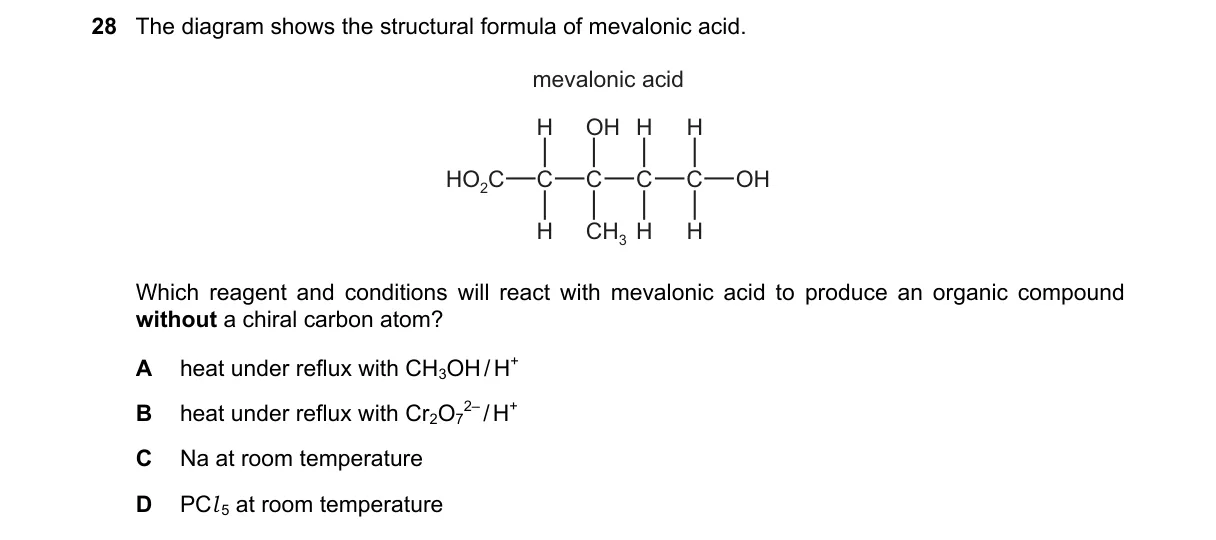
- Identify mevalonic acid structure: HOOC-CH2-C(OH)(CH3)-CH2-CH2OH, chiral at central C due to four different substituents (OH, CH3, -CH2COOH, -CH2CH2OH).
- Apply Jones oxidation (Cr2O7^2-/H+, heat): primary -CH2OH oxidizes to -COOH, yielding HOOC-CH2-C(OH)(CH3)-CH2-COOH.
- Check central C substituents: now OH, CH3, -CH2COOH, -CH2COOH (identical arms).
- Confirm no chirality: two identical substituents prevent four distinct groups.
Why B is correct:
- Jones oxidation converts the primary alcohol to carboxylic acid, creating a symmetric molecule where the former chiral carbon has two identical -CH2COOH groups, per the definition of chirality requiring four different substituents.
Why the others are wrong:
- A: Esterification with CH3OH forms methyl ester at COOH, but ends remain -CH2COOCH3 vs. -CH2CH2OH (different), retaining chirality.
- C: Na reduces COOH to salt (with H2 evolution), but substituents unchanged, preserving chirality.
- D: PCl3 replaces OH with Cl, yielding -CH2Cl and tertiary Cl, but ends -CH2CH2COOH vs. -CH2Cl (different), keeping chirality.
Final answer: B
Topic: Hydroxy compounds
Practice more A Levels Chemistry (9701) questions on mMCQ.me