A Levels Chemistry (9701)•9701/13/M/J/22
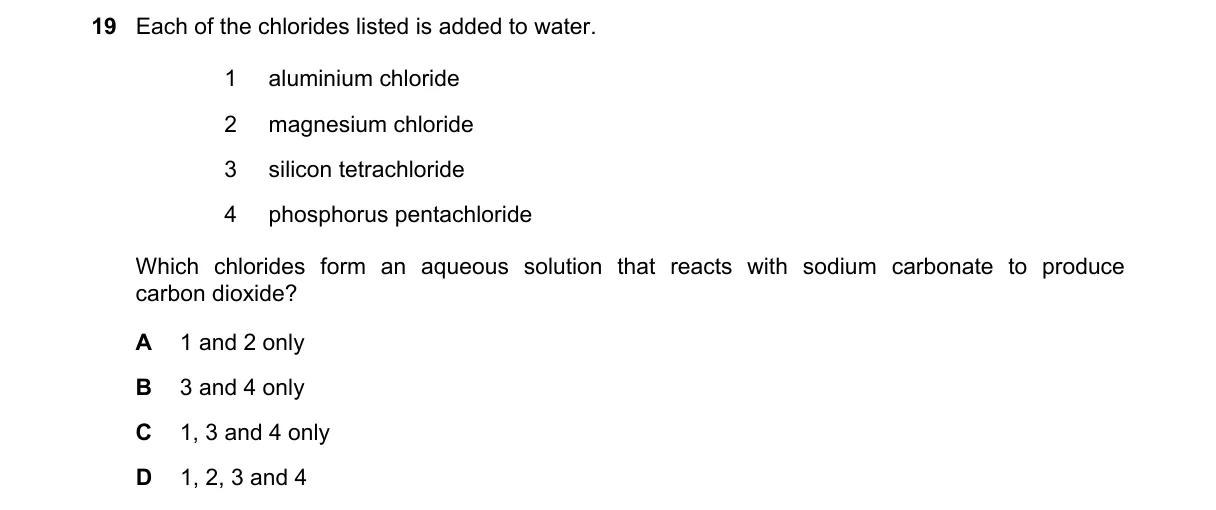
Explanation
Acidic solutions from chloride hydrolysis react with Na2CO3 to produce CO2
Steps:
- Identify chlorides that hydrolyze in water to form H+ ions, enabling reaction with Na2CO3 via 2H+ + CO3^2- → H2O + CO2.
- AlCl3 hydrolyzes: AlCl3 + 3H2O → Al(OH)3 + 3HCl, producing acidic solution.
- MgCl2 dissolves to Mg^2+ and Cl-, neutral salt with minimal hydrolysis.
- SiCl4 hydrolyzes: SiCl4 + 4H2O → Si(OH)4 + 4HCl, producing acidic solution.
- PCl5 hydrolyzes: PCl5 + 4H2O → H3PO4 + 5HCl, producing acidic solution.
Why C is correct:
- Option C selects 1, 3, and 4, whose hydrolysis yields H+ ions that acidify the solution and react with carbonate per the acid-base reaction formula.
Why the others are wrong:
- A omits acidic 3 and 4 while including neutral 2.
- B omits acidic 1 while including neutral 2.
- D includes neutral 2, which forms no CO2.
Final answer: C
Topic: The Periodic Table: chemical periodicity
Practice more A Levels Chemistry (9701) questions on mMCQ.me