A Levels Chemistry (9701)•9701/12/M/J/22
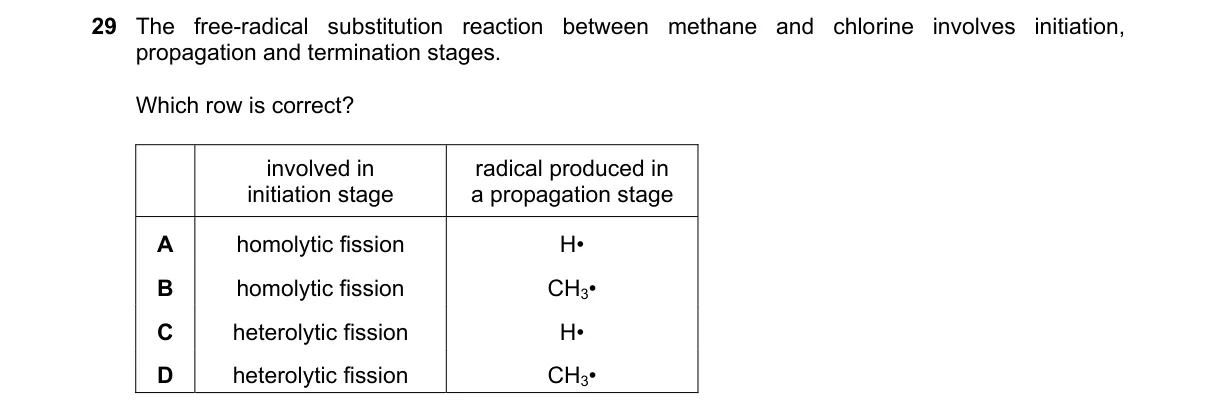
Explanation
Initiation in free-radical substitution Steps:
- Recall that free-radical substitution of methane with chlorine starts with initiation under UV light.
- Identify initiation as breaking the Cl-Cl bond to form chlorine radicals.
- Recognize homolytic fission splits bonds evenly, producing two radicals.
- Match this to the option describing even splitting yielding Cl• species.
Why A is correct:
- Initiation involves homolytic fission of Cl₂ to form two Cl• radicals, as defined by free-radical mechanism where UV energy causes equal bond cleavage (Cl₂ → 2Cl•).
Why the others are wrong:
- B: Heterolytic fission produces ions like Cl⁺ and Cl⁻, not radicals, so it describes ionic mechanisms, not free-radical.
- C: Homolytic fission of H• occurs in propagation (from CH₄), not initiation.
- D: Heterolytic fission cannot produce CH₃• radical; it yields ions like CH₃⁺.
Final answer: A
Topic: Hydrocarbons
Practice more A Levels Chemistry (9701) questions on mMCQ.me