A Levels Chemistry (9701)•9701/12/M/J/22
Explanation
Temperature-dependent disproportionation of chlorine in NaOH
Steps:
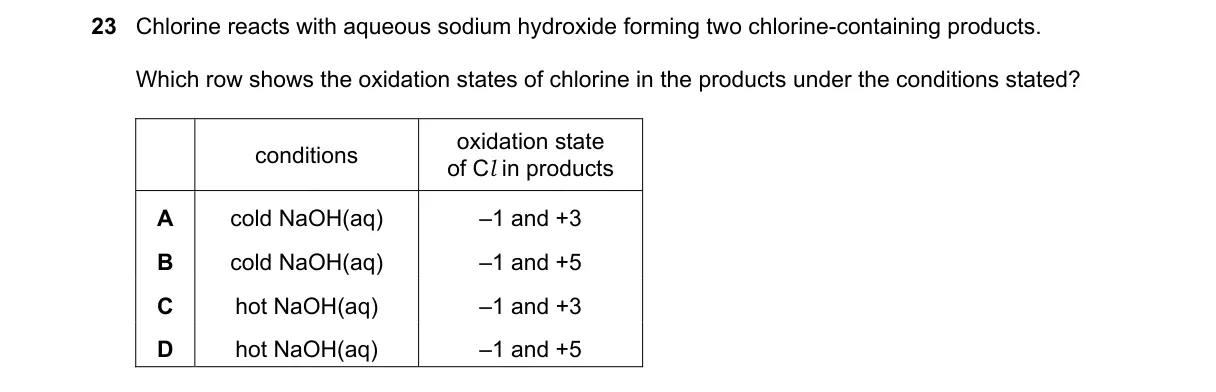
- Chlorine undergoes disproportionation with aqueous NaOH, where Cl(0) forms products with different oxidation states.
- In cold NaOH(aq), reaction is Cl₂ + 2NaOH → NaCl + NaClO + H₂O; Cl oxidation states: -1 in Cl⁻, +1 in ClO⁻.
- In hot NaOH(aq), reaction is 3Cl₂ + 6NaOH → 5NaCl + NaClO₃ + 3H₂O; Cl oxidation states: -1 in Cl⁻, +5 in ClO₃⁻.
- Match options to conditions: only D correctly identifies -1 and +5 for hot NaOH(aq).
Why D is correct:
- Hot concentrated NaOH produces chlorate (ClO₃⁻, Cl = +5) and chloride (Cl⁻, -1), per the balanced equation 3Cl₂ + 6NaOH → 5NaCl + NaClO₃ + 3H₂O.
Why the others are wrong:
- A: Cold NaOH yields +1 (not -3) in hypochlorite.
- B: Hot NaOH yields +5 (not -5) in chlorate.
- C: Cold NaOH yields +1 (not +5) in hypochlorite.
Final answer: D
Topic: Group 17
Practice more A Levels Chemistry (9701) questions on mMCQ.me