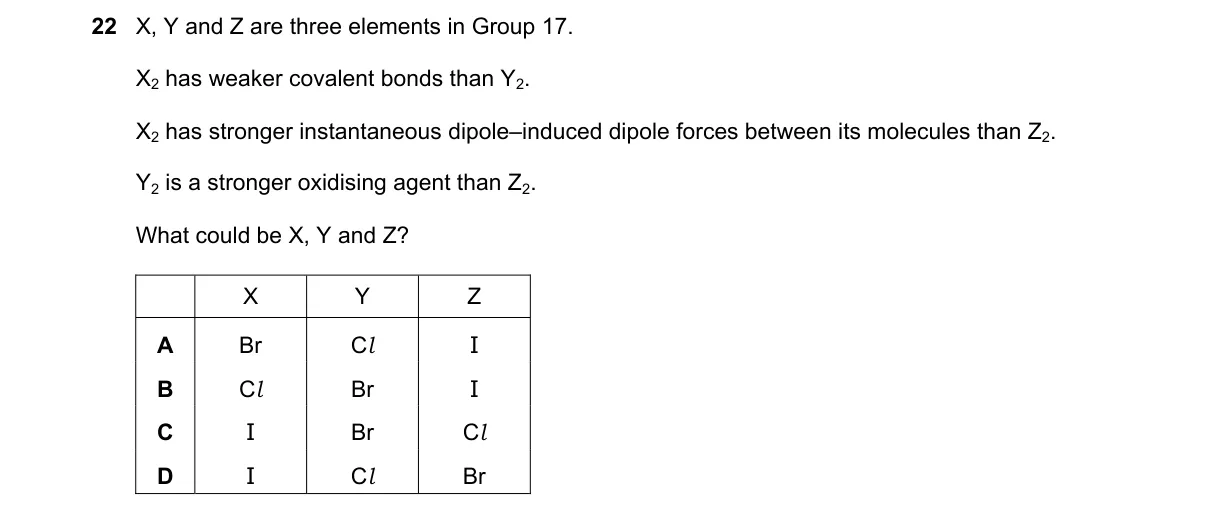
Explanation
Halogen trends in bond strength, dispersion forces, and oxidizing power Steps: - Bond dissociation energies decrease down Group 17 (Cl-Cl > Br-Br > I-I), so X-X < Y-Y means X is below Y. - London dispersion forces increase with molecular size down the group (I > Br > Cl), so X > Z means X is below Z. - Oxidizing strength decreases down the group (Cl > Br > I), so Y > Z means Y is above Z. - Assign X = I (weakest bonds, strongest dispersion); Y = Cl (strongest bonds among options, above Z); Z = Br (below X, below Y). Why D is correct: - D assigns X = I (weak I-I bonds < Cl-Cl; strong I2 dispersion > Br2), Y = Cl (stronger oxidant than Br per electrode potential trend E° Cl2/Cl⁻ > Br2/Br⁻). Why the others are wrong: - A: Cl-Cl bonds (243 kJ/mol) > Br-Br (193 kJ/mol), violating X weaker than Y. - B: Identical to D, but listed separately; does not fit as unique option. - C: Br weaker oxidant than Cl …
Practice more A Levels Chemistry (9701) questions on mMCQ.me