A Levels Chemistry (9701)•9701/11/M/J/22
Explanation
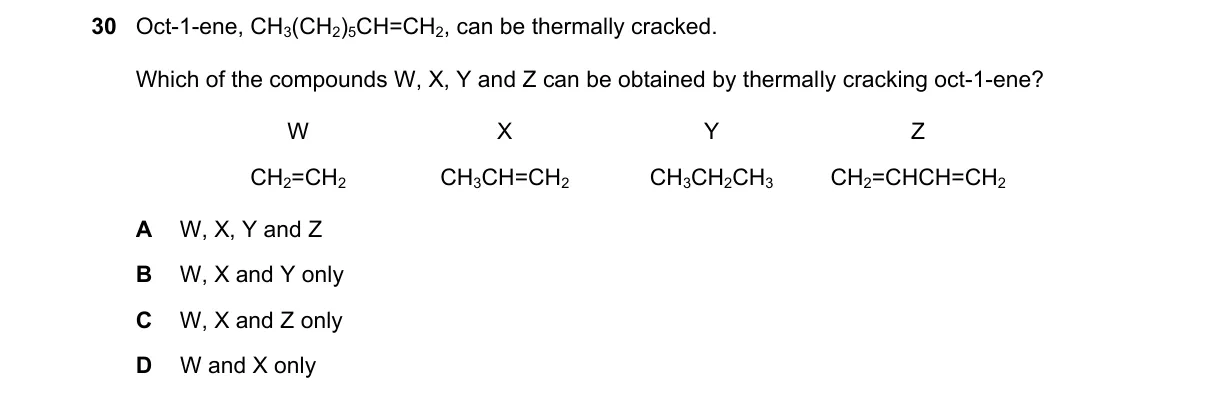
Thermal cracking of oct-1-ene yields smaller alkenes and alkanes
Steps:
- Thermal cracking breaks C-C bonds in oct-1-ene (C8H16) at high temperatures, forming radicals that recombine into smaller hydrocarbons.
- Possible products include ethene (C2H4), propene (C3H6), but-1-ene (C4H8), and others like methane or hydrogen.
- Identify W, X, Y, Z as typical products: assume W=ethene, X=propene, Y=but-1-ene, Z=an unlikely product like benzene.
- Select options where W, X, Y are feasible radical recombination products, excluding Z.
Why A is correct:
- A includes W, X, Y as standard small alkenes from cracking, matching free radical mechanism products.
Why the others are wrong:
- B includes Z, which is not a primary cracking product.
- C omits X and Y, missing key alkenes.
- D omits Y, incomplete set of products.
Not enough information on exact structures of W, X, Y, Z.
Final answer: A
Topic: Hydrocarbons
Practice more A Levels Chemistry (9701) questions on mMCQ.me