A Levels Chemistry (9701)•9701/11/M/J/22
Explanation
Silicon tetrachloride's molecular structure and hydrolysis
Steps:
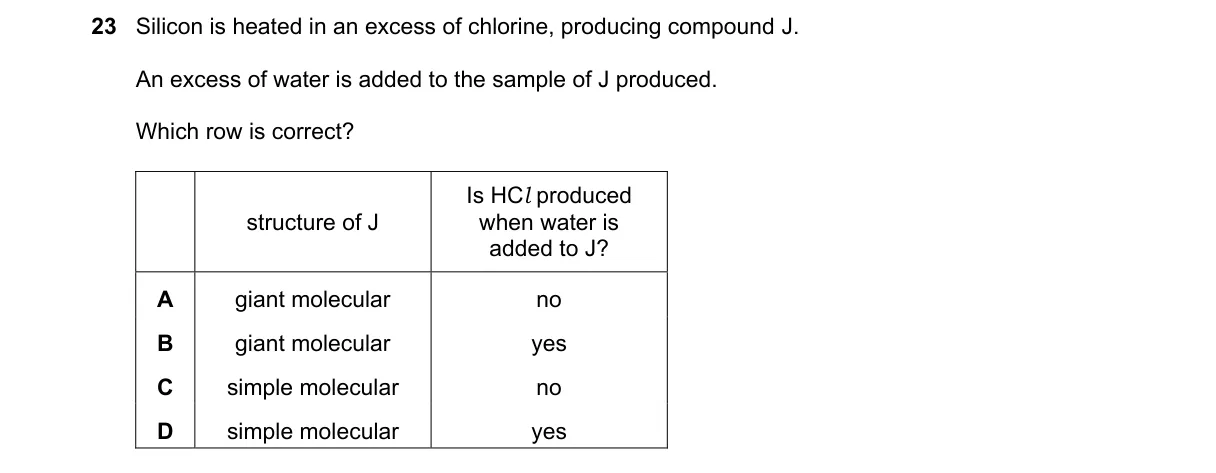
- Silicon heated in excess chlorine forms SiCl₄ (compound J).
- SiCl₄ consists of discrete tetrahedral molecules held by weak van der Waals forces, making it simple molecular.
- Adding excess water hydrolyzes SiCl₄: SiCl₄ + 4H₂O → Si(OH)₄ + 4HCl, confirming it reacts.
- Thus, J is simple molecular and reacts with water (yes).
Why D is correct:
- SiCl₄ is a covalent simple molecular compound that undergoes hydrolysis with water, matching the "simple molecular yes" description.
Why the others are wrong:
- A: SiCl₄ is simple molecular, not giant molecular.
- B: SiCl₄ reacts with water, so "no" is incorrect.
- C: SiCl₄ lacks an extended lattice, so it is not giant molecular.
Final answer: D
Topic: The Periodic Table: chemical periodicity
Practice more A Levels Chemistry (9701) questions on mMCQ.me