Explanation
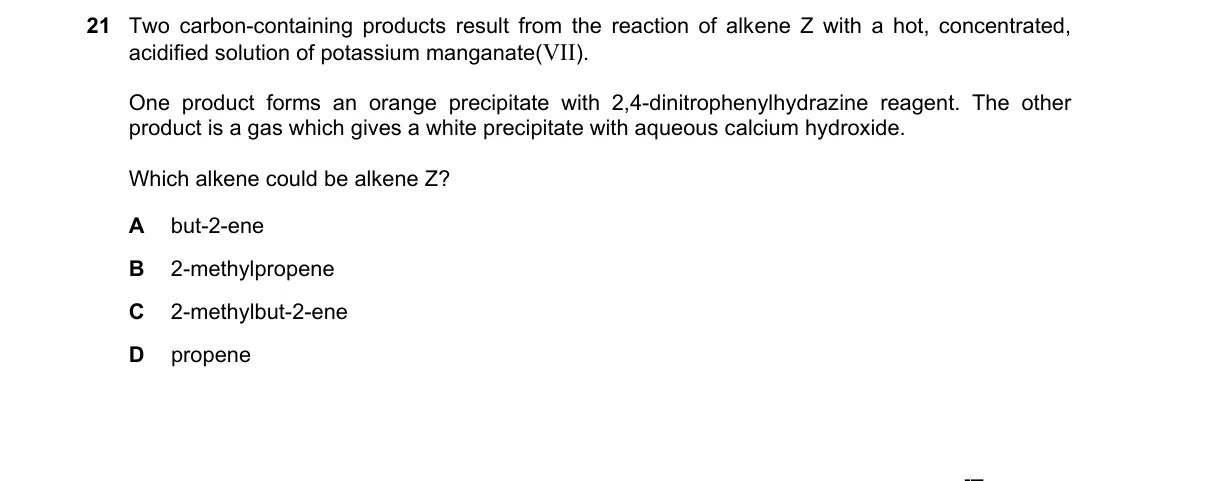
Oxidative cleavage producing HCHO gas and a stable ketone Steps: - Hot, concentrated, acidified KMnO4 cleaves the C=C bond of alkenes into carbonyl compounds: =CH2 → HCHO, =CHR → RCHO (further oxidizes to RCOOH), =CR2 → R2C=O (stable). - The gas product is HCHO (bp -19°C), which forms a white hydrazone precipitate with 2,4-DNPH, confirming an aldehyde gas. - Alkene Z must have =CH2 to yield HCHO gas and a =CR2 group to yield an unoxidizable ketone as the other product. - Thus, cleavage gives two carbon-containing products: HCHO gas and a ketone. Why B is correct: - 2-Methylpropene (CH2=C(CH3)2) cleaves to HCHO + (CH3)2C=O (acetone), matching the gas and stable ketone. Why the others are wrong: - A. But-1-ene (CH2=CHCH2CH3) cleaves to HCHO + CH3CH2CHO; the aldehyde oxidizes further to CH3CH2COOH, yielding acid + gas, not two carbonyls. - C. 2-Methylbut-2-ene ((CH3)2C=CHCH3) cleaves to (CH3)2C=O + CH3CHO; no =CH2, so no HCHO gas (acetaldehyde bp 21°C is volatile liquid). - D. Propene (CH2=CHCH3) cleaves to HCHO + CH3CHO; the aldehyde oxidizes to CH3COOH, yielding acid + gas, not two …
Practice more A Levels Chemistry (9701) questions on mMCQ.me