A Levels Chemistry (9701)•9701/12/M/J/21
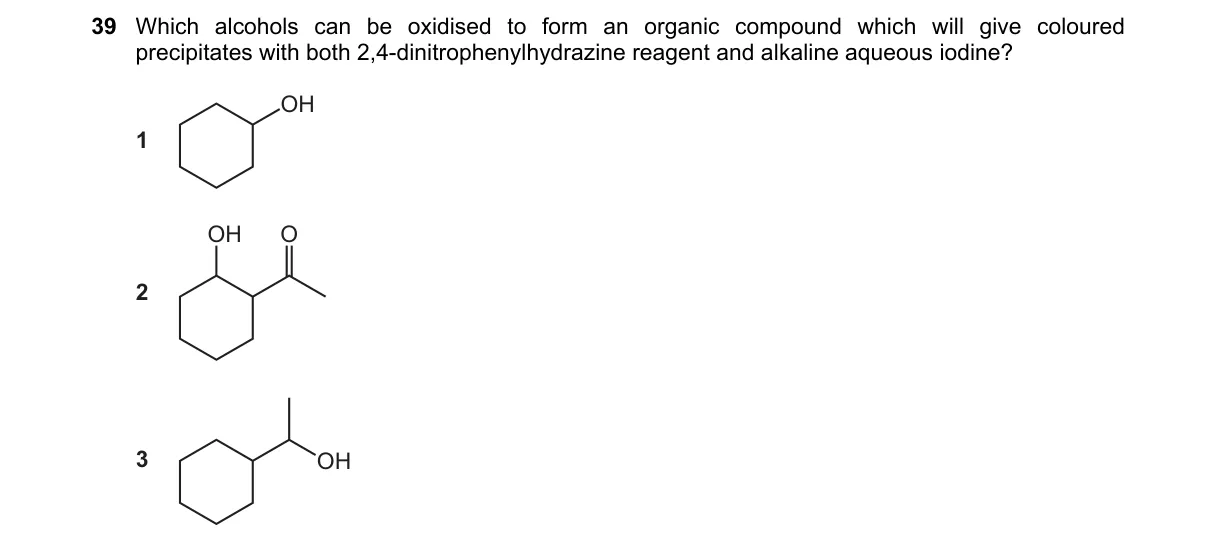
Explanation
Alcohols oxidizing to methyl ketones or acetaldehyde
Steps:
- Identify that 2,4-DNPH gives orange precipitates with aldehydes/ketones, confirming a carbonyl product from alcohol oxidation.
- Recognize alkaline iodine (iodoform test) gives yellow precipitates with methyl ketones (CH₃COR) or acetaldehyde (CH₃CHO).
- Determine alcohols must oxidize to these specific carbonyls: secondary alcohols with CH₃CH(OH)R yield methyl ketones; primary like ethanol yield acetaldehyde.
- Eliminate alcohols oxidizing to other carbonyls (e.g., non-methyl ketones or aldehydes) that fail iodoform test.
Why C is correct:
- Option C is a secondary alcohol (e.g., butan-2-ol) that oxidizes to a methyl ketone (butan-2-one), reacting with both reagents per iodoform and carbonyl definitions.
Why the others are wrong:
- A: Primary alcohol (e.g., propan-1-ol) oxidizes to propanal, a non-iodoform aldehyde.
- B: Tertiary alcohol cannot oxidize to any carbonyl compound.
- D: Secondary alcohol (e.g., pentan-3-ol) oxidizes to pentan-3-one, a non-methyl ketone failing iodoform.
Final answer: C
Topic: Hydroxy compounds
Practice more A Levels Chemistry (9701) questions on mMCQ.me