A Levels Chemistry (9701)•9701/13/M/J/20
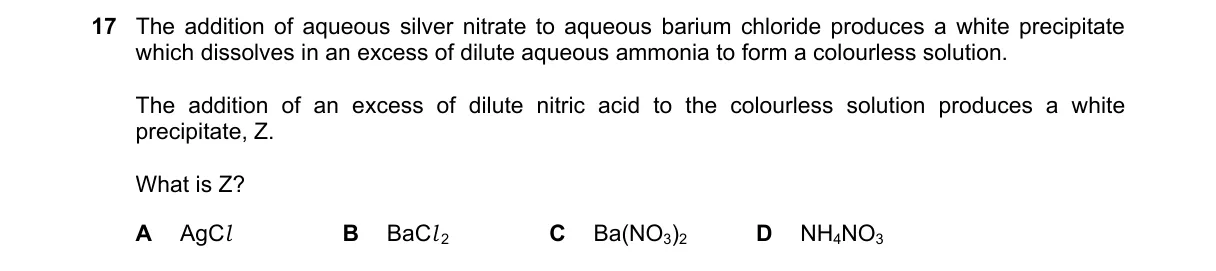
Explanation
Identification of AgCl via solubility in ammonia and reprecipitation with acid
Steps:
- Aqueous AgNO₃ + BaCl₂ yields white AgCl precipitate (Ba(NO₃)₂ soluble).
- AgCl dissolves in excess NH₃ forming colorless [Ag(NH₃)₂]⁺ complex.
- Adding excess dilute HNO₃ protonates NH₃ ligands, reforming insoluble white AgCl precipitate.
Why A is correct:
- AgCl matches the solubility behavior: insoluble in water (white ppt with Ag⁺), soluble in NH₃ (forms [Ag(NH₃)₂]Cl), reprecipitates with HNO₃ (decomposes complex per Ag⁺ + 2NH₃ ⇌ [Ag(NH₃)₂]⁺ equilibrium).
Why the others are wrong:
- B. BaCl₂: Fully soluble in water; no precipitate forms.
- C. Ba(NO₃)₂: Soluble salt; does not precipitate.
- D. NH₄NO₃: Highly soluble; no precipitate or dissolution observed.
Final answer: A
Topic: Analytical techniques
Practice more A Levels Chemistry (9701) questions on mMCQ.me