A Levels Chemistry (9701)•9701/12/M/J/20
Explanation
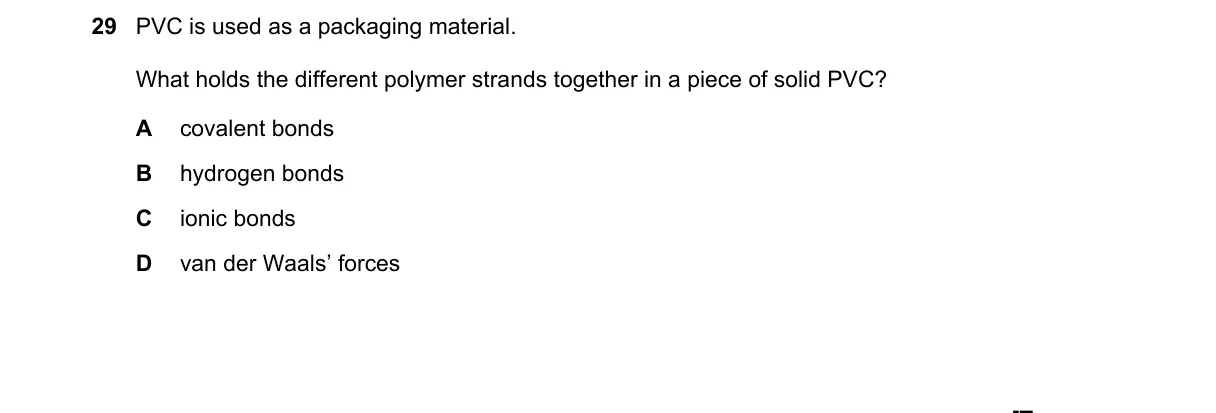
Intermolecular forces in PVC polymers
Steps:
- Identify PVC as a non-polar polymer made of repeating vinyl chloride units.
- Recognize that within each chain, atoms are linked by strong covalent bonds.
- Note that between separate polymer strands in solid PVC, only weak attractions hold them together.
- Determine the type of weak force: van der Waals, as PVC lacks polar groups for stronger bonds.
Why D is correct:
- Van der Waals forces are weak London dispersion attractions between non-polar polymer chains, allowing PVC to form a solid via intermolecular cohesion (defined as temporary dipole interactions).
Why the others are wrong:
- A. Covalent bonds form the backbone within each polymer strand, not between strands.
- B. Hydrogen bonds require electronegative atoms like N, O, or F with attached H; PVC (C-H, C-Cl) lacks these.
- C. Ionic bonds occur between charged ions; PVC is a covalent organic polymer without ions.
Final answer: D
Topic: Polymerisation
Practice more A Levels Chemistry (9701) questions on mMCQ.me