A Levels Chemistry (9701)•9701/12/M/J/20
Explanation
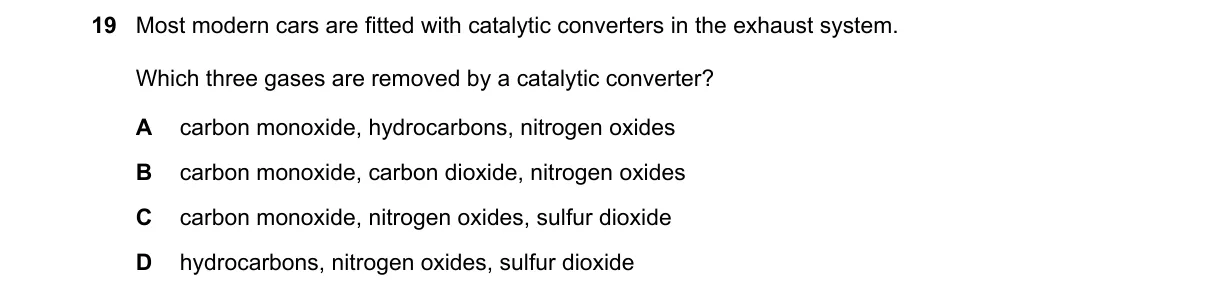
Catalytic converters target specific exhaust pollutants
Steps:
- Identify the primary pollutants from car engines: carbon monoxide (CO) from incomplete combustion, unburned hydrocarbons (HC) as fuel residues, and nitrogen oxides (NOx) from high-temperature reactions.
- Recall that catalytic converters use platinum, palladium, and rhodium to facilitate redox reactions converting these gases into less harmful substances.
- Eliminate options with carbon dioxide (CO2), which is already a product, not a pollutant removed.
- Confirm the standard trio of gases reduced in modern automotive exhaust systems.
Why A is correct:
- Catalytic converters oxidize CO to CO2, HC to CO2 and H2O, and reduce NOx to N2 and O2, as defined by EPA standards for vehicle emissions control.
Why the others are wrong:
- B includes CO2, a non-pollutant byproduct not removed by converters.
- C includes sulfur oxides, which are minimized by low-sulfur fuel but not primarily targeted by converters.
- D includes sulfur dioxide, a diesel-related pollutant handled separately, not by standard gasoline car converters.
Final answer: A
Topic: Chemistry of transition elements
Practice more A Levels Chemistry (9701) questions on mMCQ.me