A Levels Chemistry (9701)•9701/12/M/J/20
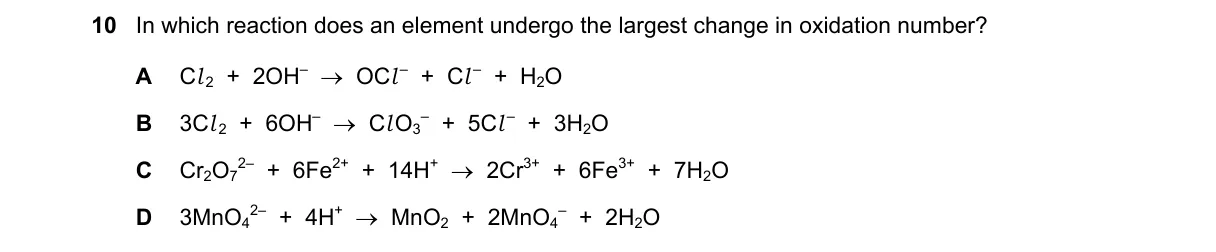
Explanation
Greatest increase in oxidation number for an element Steps:
- Calculate oxidation numbers for changing elements in each reaction.
- Identify the magnitude of change (increase or decrease) per atom.
- Compare increases: oxidation involves rise in oxidation number.
- Select reaction with largest positive Δ(oxidation number).
Why B is correct:
- Sulfur increases from +4 in SO₃²⁻ to +6 in SO₄²⁻, a +2 change, the largest oxidation shown.
Why the others are wrong:
- A: Chlorine increases from 0 to +1 (+1 change) or decreases to -1 in disproportionation.
- C: Iron increases from +2 to +3 (+1 change); chromium decreases from +6 to +2.
- D: Manganese decreases from +7 in MnO₄⁻ to +4 in MnO₂ (-3 change) or to +6 in MnO₄²⁻ (assuming manganate, -1 change).
Final answer: B
Topic: Chemistry of transition elements
Practice more A Levels Chemistry (9701) questions on mMCQ.me