A Levels Chemistry (9701)•9701/11/M/J/20
Explanation
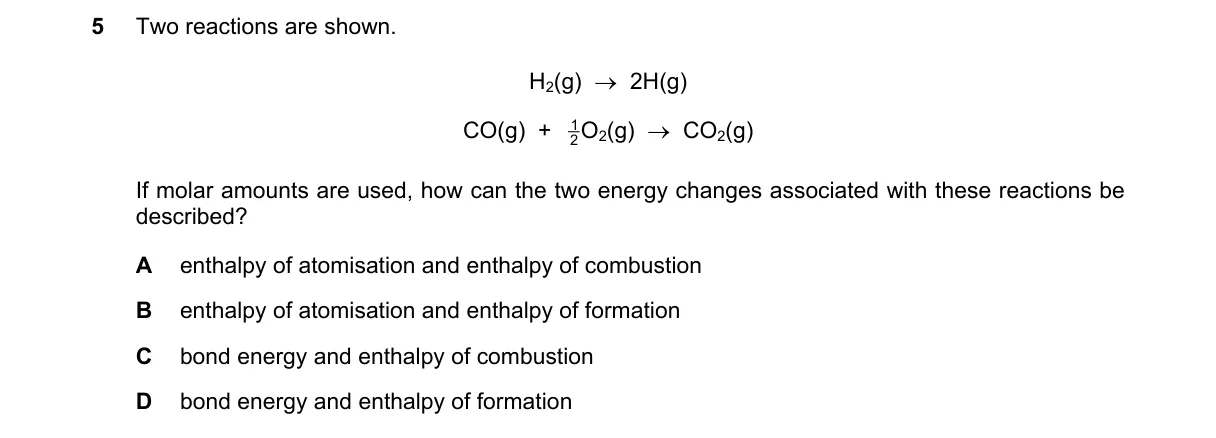
Identifying reaction enthalpies from standard definitions
Steps:
- Examine first reaction: H₂(g) + ½O₂(g) → H₂O(g) forms water from elements in standard states.
- Examine second reaction: CO(g) + ½O₂(g) → CO₂(g) burns one mole of CO completely in oxygen.
- Match first to standard enthalpy of formation (ΔH_f°), energy change for forming one mole of compound from elements.
- Match second to standard enthalpy of combustion (ΔH_c°), energy released when one mole of substance combusts fully.
Why B is correct:
- B aligns with definitions: first reaction is exactly ΔH_f°(H₂O,g); second is ΔH_c°(CO,g) per Hess's law for standard states.
Why the others are wrong:
- A: Atomisation enthalpies convert elements to gaseous atoms (e.g., H₂ → 2H), not forming molecular compounds.
- C: Bond energies are averages for breaking specific bonds in isolation, unrelated to these overall reaction enthalpies.
- D: Identical to C, so equally mismatched.
Final answer: B
Topic: Chemical energetics
Practice more A Levels Chemistry (9701) questions on mMCQ.me