A Levels Chemistry (9701)•9701/11/M/J/20
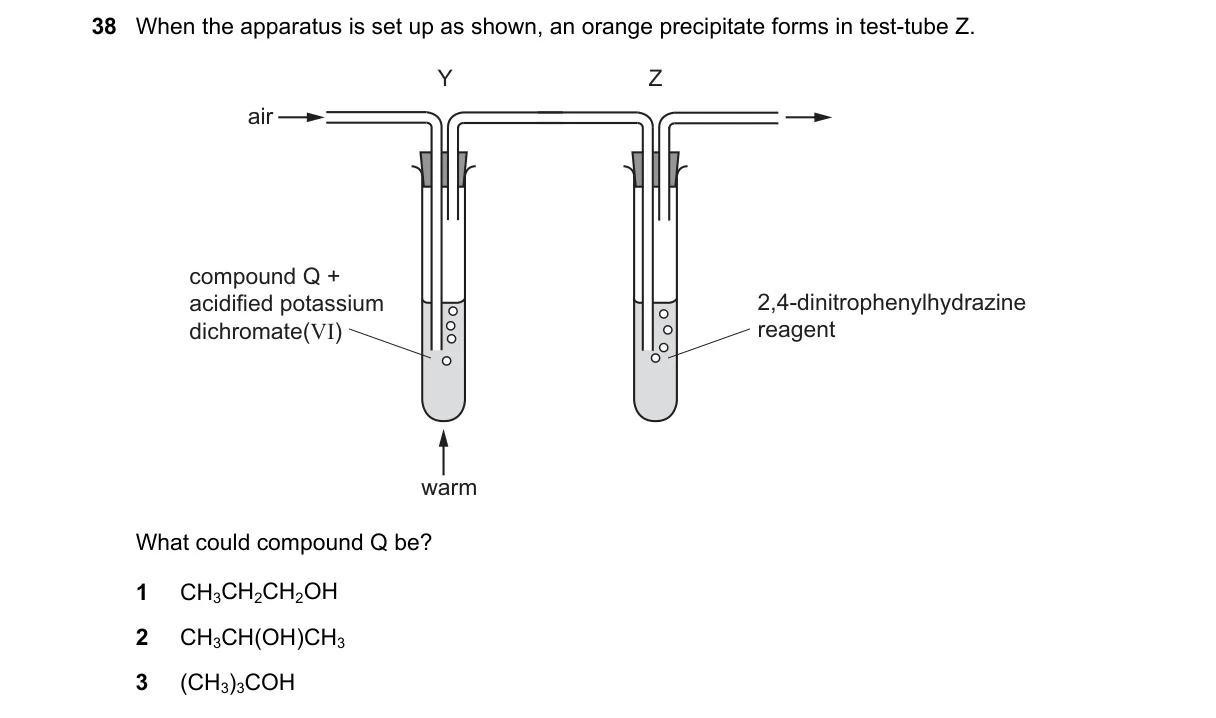
Explanation
Fehling's test identifies aldehydes via orange precipitate
Steps:
- Observe orange precipitate in test tube Z, indicating a positive Fehling's test for reducing agents like aldehydes.
- Recall Fehling's reagent (alkaline Cu²⁺ solution) is reduced by aldehydes to red-orange Cu₂O precipitate.
- Examine options: only aldehydes among them reduce the reagent.
- Identify CH₃CHO as the aldehyde that fits the reaction.
Why B is correct:
- CH₃CHO (acetaldehyde) has the aldehydic group (-CHO) that undergoes oxidation, reducing Cu²⁺ to Cu₂O for the orange precipitate (RCHO + 2Cu²⁺ + 5OH⁻ → RCOO⁻ + Cu₂O + 3H₂O).
Why the others are wrong:
- A: CH₃CH₂OH (ethanol) is an alcohol, lacks reducing group, no reaction.
- C: CH₃COCH₃ (acetone) is a ketone, does not reduce Fehling's reagent.
- D: CH₃COOH (acetic acid) is a carboxylic acid, already oxidized, no precipitate.
Final answer: B
Topic: Carbonyl compounds
Practice more A Levels Chemistry (9701) questions on mMCQ.me