Explanation
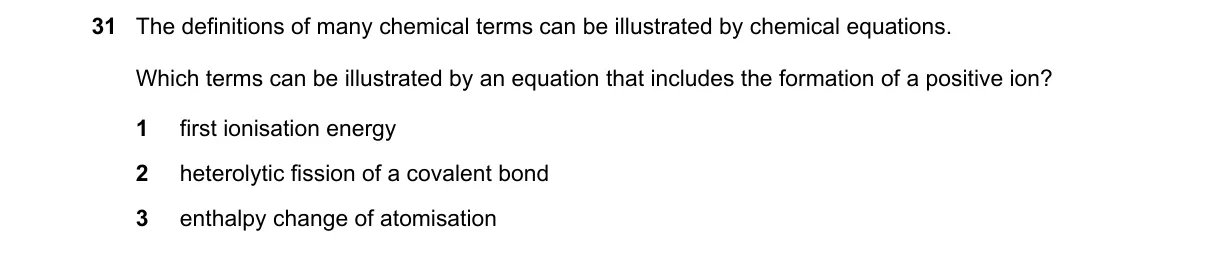
Heterolytic fission forms a positive ion during bond cleavage Steps: - Recall definitions: first ionisation energy is energy to remove an electron from a gaseous atom; heterolytic fission is uneven bond breaking yielding ions; atomisation enthalpy converts elements to gaseous atoms. - Examine equations: ionisation shows X(g) → X⁺(g) + e⁻; fission shows R–X → R⁺ + X⁻; atomisation shows e.g. Na(s) → Na(g). - Identify which term's defining equation depicts positive ion formation as a key outcome of the process. - Select the term where ion formation directly illustrates the definition. Why B is correct: - Heterolytic fission is defined as covalent bond cleavage where one atom retains both electrons, forming a positive ion (cation) and negative ion, as in CH₃–Cl → CH₃⁺ + Cl⁻. Why the others are wrong: - A: First ionisation energy defines the energy change for electron removal from an isolated atom to form X⁺, not a bond-breaking process involving ion pair formation. - C: Enthalpy change of atomisation defines energy to form neutral gaseous atoms, e.g. ½Cl₂(g) → Cl(g), with no ions produced. - …
Practice more A Levels Chemistry (9701) questions on mMCQ.me