A Levels Chemistry (9701)•9701/11/M/J/20
Explanation
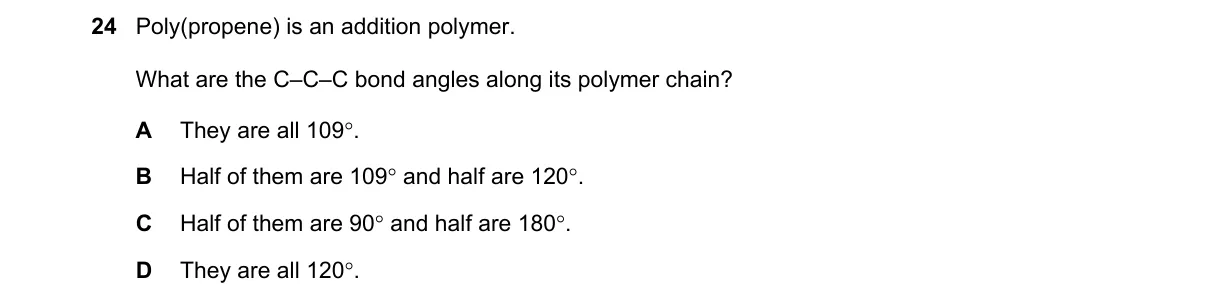
Polypropene chain features tetrahedral carbon geometry
Steps:
- Polypropene forms from propene via addition polymerization, creating a saturated hydrocarbon chain.
- The repeating unit is -[CH₂-CH(CH₃)]-, with all backbone carbons bonded to four single bonds.
- These carbons are sp³ hybridized, adopting tetrahedral electron geometry.
- Tetrahedral geometry dictates C-C-C bond angles of 109.5° throughout the chain.
Why A is correct:
- sp³ hybridized carbons in alkanes and saturated polymers like polypropene follow VSEPR theory, resulting in tetrahedral 109° bond angles.
Why the others are wrong:
- B: 120° angles indicate sp² hybridization with double bonds, absent in polypropene's saturated chain.
- C: 90° angles do not occur in organic carbon chains; they suggest octahedral or other geometries not applicable here.
- D: All 120° implies a planar, conjugated system like in aromatic polymers, but polypropene is aliphatic and non-planar.
Final answer: A
Topic: Polymerisation
Practice more A Levels Chemistry (9701) questions on mMCQ.me