A Levels Chemistry (9701)•9701/13/M/J/19
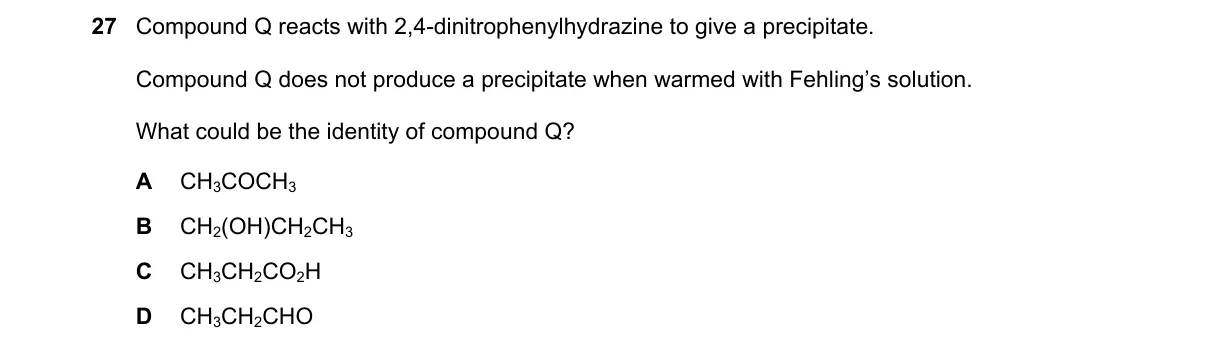
Explanation
Carbonyl compound identification via selective tests
Steps:
- Positive DNPH test indicates a carbonyl group (aldehyde or ketone) in Q, as it forms a hydrazone precipitate.
- Negative Fehling's test means Q lacks reducing properties, ruling out aldehydes but allowing ketones.
- Examine options: A is an alkane (no carbonyl); B and D are aldehydes (CH3CH2CHO); C is a ketone (CH3CH2COCH3).
- Only C fits both tests: carbonyl for DNPH, non-reducing for Fehling's.
Why C is correct:
- CH3CH2COCH3 (butanone) has C=O group reacting with DNPH per hydrazone formation, but as a ketone, it resists oxidation by Cu2+ in Fehling's (aldehydes reduce to carboxylic acids, giving red Cu2O precipitate).
Why the others are wrong:
- A: CH3CH2CH3 (propane) lacks carbonyl, so no DNPH precipitate.
- B: CH3CH2CHO (propanal) is an aldehyde, reacts with both DNPH and Fehling's (positive reducing test).
- D: Identical to B, so same error as B.
Final answer: C
Topic: Carbonyl compounds
Practice more A Levels Chemistry (9701) questions on mMCQ.me