A Levels Chemistry (9701)•9701/13/M/J/19
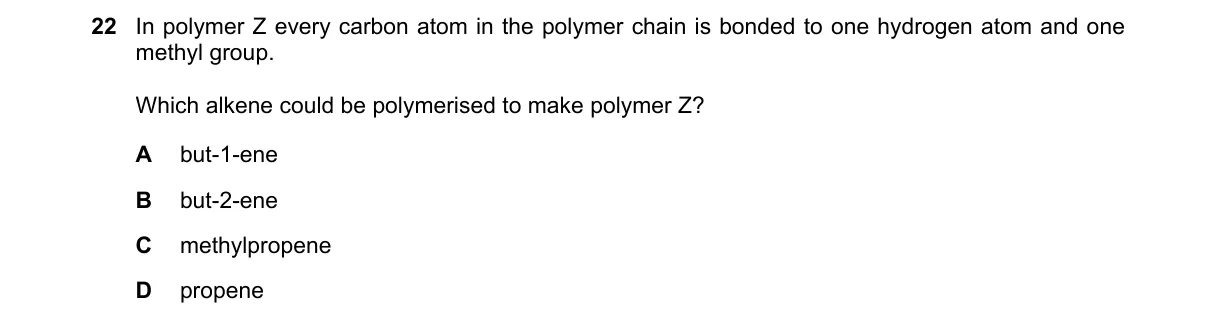
Explanation
Polymerization of symmetrical alkenes yields uniform substituents
Steps:
- Identify the repeating unit in polymer Z: -[CH(CH3)-CH(CH3)]-, where each chain carbon bonds to one H and one CH3.
- Recall addition polymerization opens the alkene double bond, forming the chain from the monomer's structure.
- Match the monomer to produce identical substituents on each carbon: requires CH3-CH=CH-CH3.
- Confirm but-2-ene polymerizes to -[CH(CH3)-CH(CH3)]-n, fitting the description.
Why B is correct:
- But-2-ene (CH3-CH=CH-CH3) undergoes addition polymerization to form -[CH(CH3)-CH(CH3)]-n, where each carbon has one H and one CH3 per the repeating unit formula.
Why the others are wrong:
- A: But-1-ene yields -[CH2-CH(CH2CH3)]-n; alternating carbons have two H or one H and one ethyl.
- C: Methylpropene yields -[CH2-C(CH3)2]-n; carbons have two H or no H and two CH3.
- D: Propene yields -[CH2-CH(CH3)]-n; alternating carbons have two H or one H and one CH3.
Final answer: B
Topic: Polymerisation
Practice more A Levels Chemistry (9701) questions on mMCQ.me