A Levels Chemistry (9701)•9701/13/M/J/19
Explanation
Parallel reactions of barium and magnesium compounds with acid and base Steps:
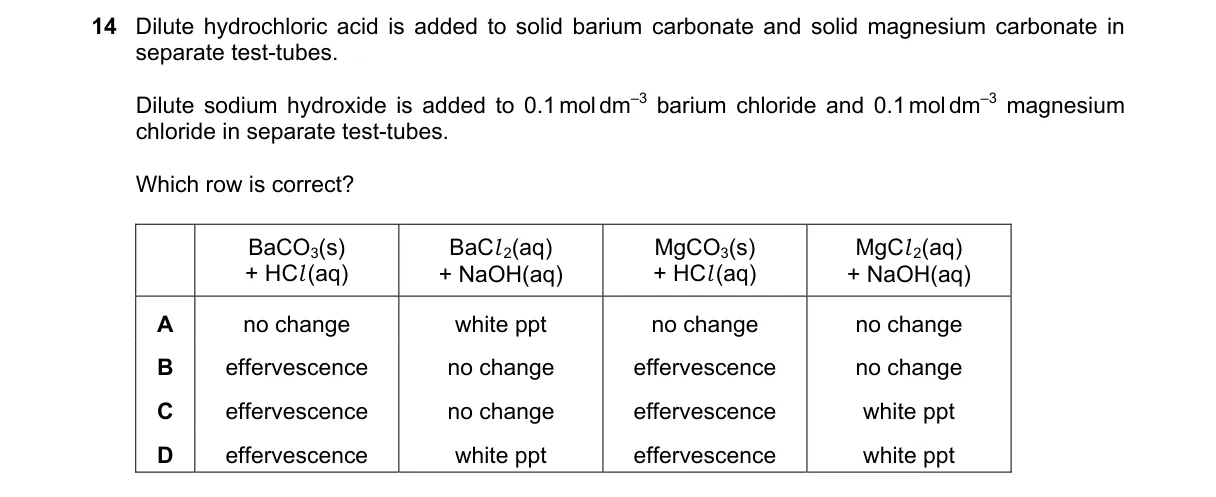
- Barium carbonate reacts with dilute HCl: BaCO₃ + 2HCl → BaCl₂ + H₂O + CO₂ (g) → effervescence from CO₂.
- Barium chloride (0.1 mol dm⁻³) with dilute NaOH forms Ba(OH)₂, soluble (solubility ~0.2 mol dm⁻³) → no visible change.
- Magnesium carbonate reacts with dilute HCl: MgCO₃ + 2HCl → MgCl₂ + H₂O + CO₂ (g) → effervescence from CO₂.
- Magnesium chloride (0.1 mol dm⁻³) with dilute NaOH forms Mg(OH)₂ (Ksp = 5.6 × 10⁻¹², insoluble) → white precipitate. Why C is correct:
- Matches observations via CO₂ evolution from carbonates (acid reaction) and differential solubility of group 2 hydroxides (Ba(OH)₂ soluble, Mg(OH)₂ insoluble at 0.1 mol dm⁻³). Why the others are wrong:
- A: Falsely predicts no reaction for carbonates with acid and precipitate for both hydroxides.
- B: Erroneously shows no effervescence for MgCO₃ + HCl and no precipitate for MgCl₂ + NaOH.
- D: Incorrectly predicts white ppt for BaCl₂ + NaOH instead of no change. Final answer: C
Topic: Group 2
Practice more A Levels Chemistry (9701) questions on mMCQ.me