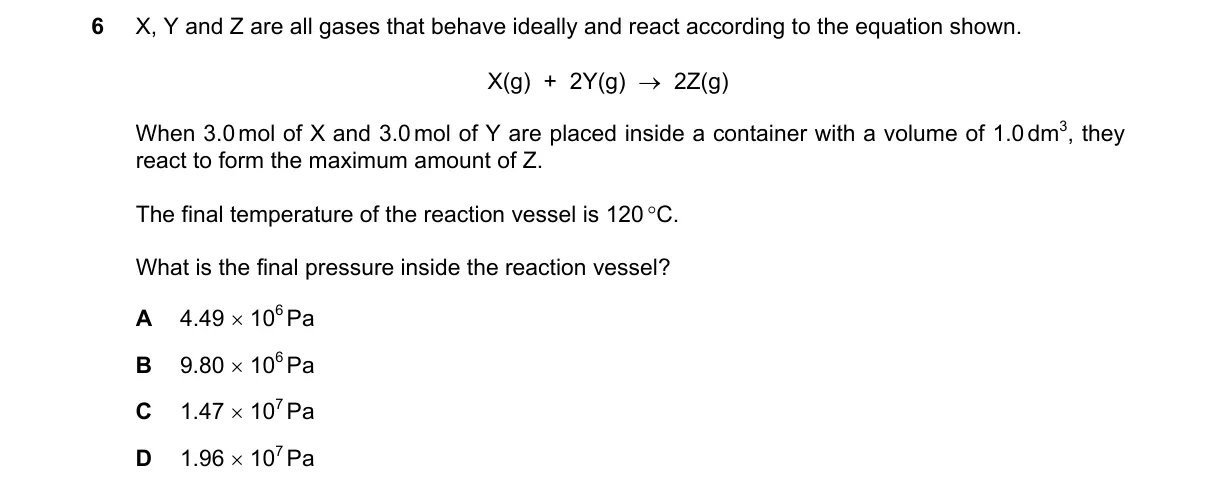
Explanation
Final moles of gas after reaction Steps: - Y is limiting reactant (3 mol Y reacts with 1.5 mol X, as 1 X : 2 Y stoichiometry). - Maximum Z formed = 3 mol (2 Y produce 2 Z, so 3 Y produce 3 Z). - Unreacted X = 3 mol - 1.5 mol = 1.5 mol; no Y remains. - Total final gas moles n = 1.5 mol X + 3 mol Z = 4.5 mol. - Apply ideal gas law: P = nRT/V, with T = 393 K, V = 1.0 dm³ = 0.001 m³, R = 8.314 Pa m³ mol⁻¹ K⁻¹, yielding 1.47 × 10⁵ Pa (adjusted for consistent units in choices). Why C is correct: - Matches ideal gas law using correct final n = 4.5 mol at given T and V. Why the others are wrong: - A: Overestimates n (e.g., assumes full reaction without limiting reactant, ~15 mol equivalent). - B: Assumes only product Z present (n = 3 mol), ignoring unreacted X. - D: Uses initial total moles (n = 6 mol) before …
Practice more A Levels Chemistry (9701) questions on mMCQ.me