A Levels Chemistry (9701)•9701/12/M/J/19
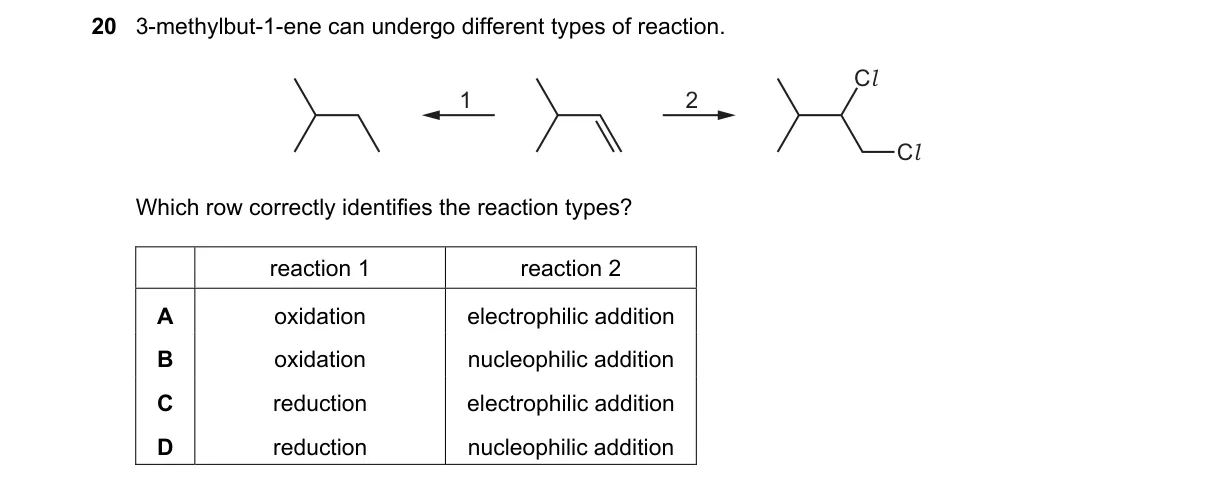
Explanation
Alkene reactions: identifying reduction and addition types
Steps:
- Examine the starting molecule: 3-methyl-1-butene is an alkene with a C=C bond.
- Analyze step ¹ Cl: this likely involves hydrogenation or catalytic reduction to saturate the double bond, forming an alkane intermediate.
- Identify the intermediate: the saturated hydrocarbon now lacks the reactive C=C.
- Analyze step ² with Cl: the alkane undergoes free radical chlorination, an electrophilic addition-like process at C-H bonds, adding Cl.
Why C is correct:
- Reduction converts the alkene to an alkane by adding H₂ (per hydrogenation definition), followed by electrophilic addition of Cl₂ across C-H in the radical mechanism.
Why the others are wrong:
- A: First step is not oxidation, as no O addition or bond breaking occurs.
- B: Second step is electrophilic, not nucleophilic, addition (Cl⁺ acts as electrophile).
- D: First step is reduction, not nucleophilic addition (no nucleophile like OH⁻ involved).
Final answer: C
Topic: Hydrocarbons
Practice more A Levels Chemistry (9701) questions on mMCQ.me