A Levels Chemistry (9701)•9701/12/M/J/19
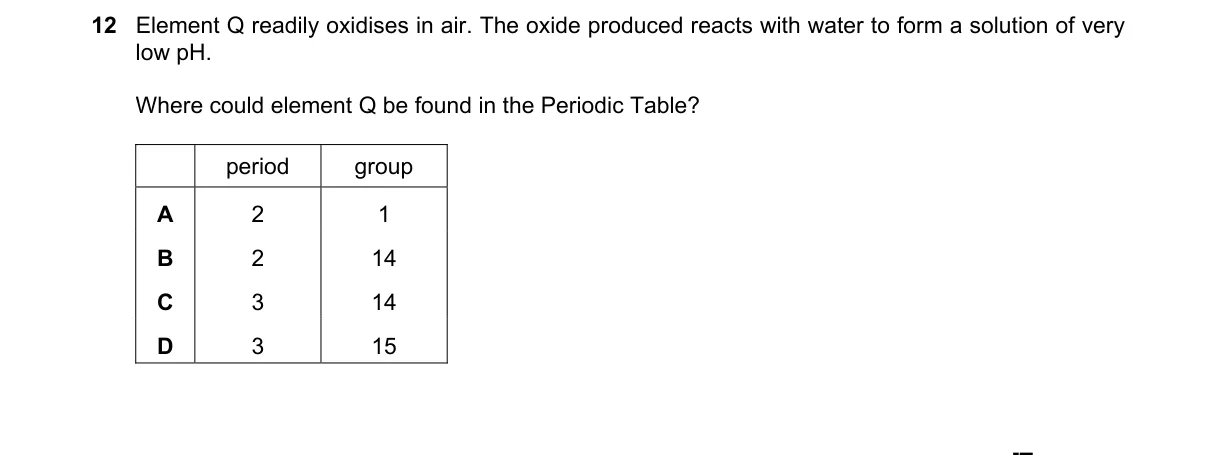
Explanation
Non-metal oxide forms strong acid with water
Steps:
- Oxide reacts with water to give very low pH solution, indicating acidic oxide from non-metal element.
- Non-metals in p-block (groups 13-18) form acidic oxides; "oxides in air" suggests combustion product.
- Period 3, group 15 element is phosphorus, which burns in air to form P₄O₁₀.
- P₄O₁₀ + 6H₂O → 4H₃PO₄, a strong acid lowering pH significantly.
Why D is correct:
- Phosphorus (period 3, group 15) oxide P₄O₁₀ hydrolyzes to phosphoric acid (H₃PO₄), a triprotic acid with pH < 2 in solution.
Why the others are wrong:
- A: Lithium (period 2, group 1) forms basic Li₂O, reacting to LiOH (high pH).
- B: Silicon (period 3, group 14) forms neutral SiO₂, insoluble in water, no pH change.
- C: Carbon (period 2, group 14) forms CO₂, yielding weak carbonic acid (pH ~4, not very low).
Final answer: D
Topic: The Periodic Table: chemical periodicity
Practice more A Levels Chemistry (9701) questions on mMCQ.me