A Levels Chemistry (9701)•9701/12/M/J/19
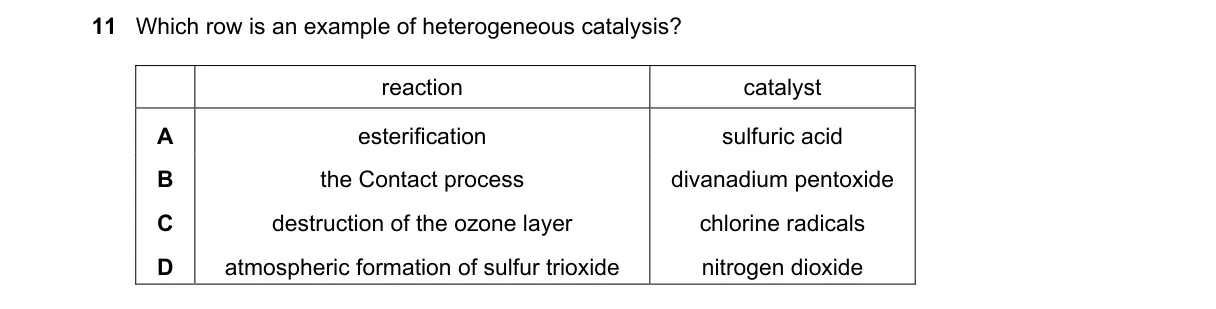
Explanation
Heterogeneous catalysis involves a catalyst in a different phase from reactants, like gas reactions on solid surfaces.
Steps:
- Define heterogeneous catalysis: catalyst and reactants in different phases, often solid surfaces catalyzing gas-phase reactions.
- Review options: identify phases of reactants and catalysts in each example.
- Check for phase mismatch: look for gas-phase reactions catalyzed by solid or surface-bound species.
- Match to known example: ozone depletion features surface reactions on ice particles.
Why B is correct:
- In ozone layer destruction, chlorine radicals form via heterogeneous reactions on polar stratospheric cloud surfaces (solid ice), releasing active Cl from gas-phase precursors, per stratospheric chemistry mechanisms.
Why the others are wrong:
- A: Esterification uses sulfuric acid catalyst in liquid phase with liquid reactants—homogeneous.
- C: Atmospheric SO3 formation occurs via gas-phase reactions with OH radicals, not solid V2O5 (which is industrial)—homogeneous.
- D: NO2 catalyzes sulfuric acid formation in gas phase with gaseous SO2—homogeneous.
Final answer: B
Topic: Reaction kinetics
Practice more A Levels Chemistry (9701) questions on mMCQ.me