A Levels Chemistry (9701)•9701/11/M/J/19
Explanation
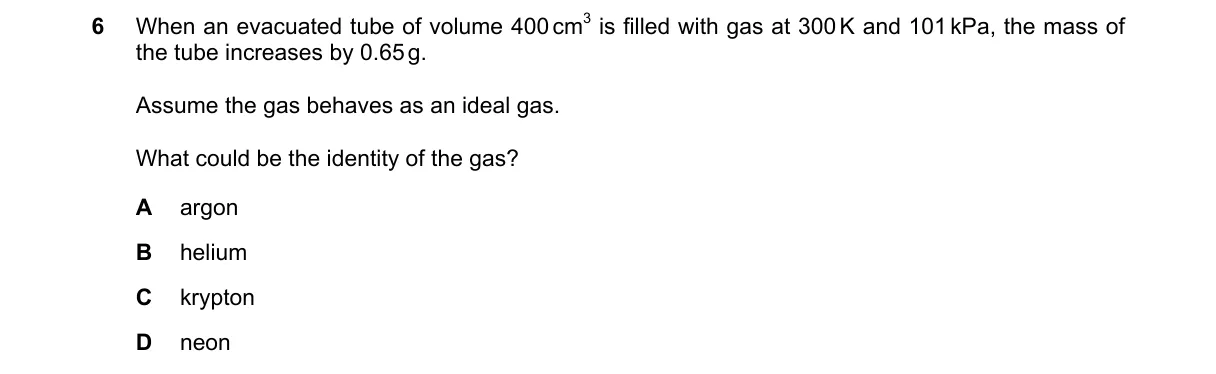
Calculate molar mass using ideal gas law
Steps:
- Convert volume: 400 cm³ = 0.0004 m³.
- Compute moles: n = (101 kPa × 0.0004 m³) / (8.314 J/mol·K × 300 K) = 0.0162 mol.
- Determine molar mass: M = 0.65 g / 0.0162 mol ≈ 40 g/mol.
- Identify gas: Matches argon's atomic mass of 40 g/mol.
Why A is correct:
- Argon's molar mass is 40 g/mol, exactly matching the calculated value from PV = nRT.
Why the others are wrong:
- B. Helium: Molar mass 4 g/mol, far below 40 g/mol.
- C. Krypton: Molar mass 84 g/mol, twice the calculated value.
- D. Neon: Molar mass 20 g/mol, half the required mass.
Final answer: A
Topic: States of matter
Practice more A Levels Chemistry (9701) questions on mMCQ.me