A Levels Chemistry (9701)•9701/11/M/J/19
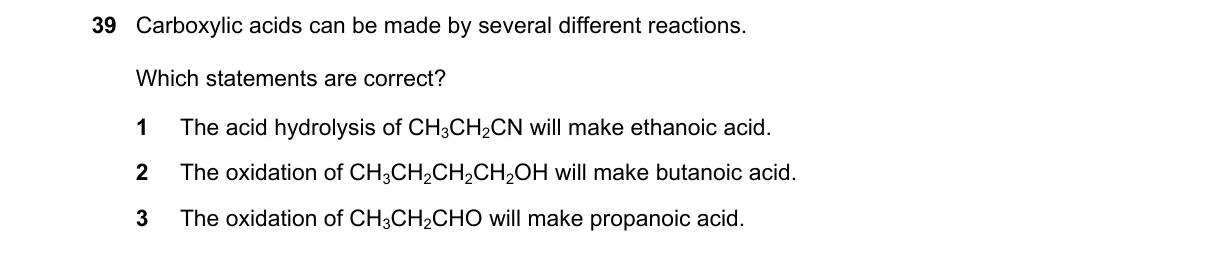
Explanation
Carboxylic Acid Synthesis via Hydrolysis and Oxidation
Steps:
- Examine A: CH3CN hydrolyzes to carboxylic acid with same carbon count, CH3COOH (ethanoic acid).
- Examine B: CH3CH2CH2OH (3-carbon primary alcohol) oxidizes to 3-carbon propanoic acid, not 4-carbon butanoic.
- Examine C: CH3CHO (2-carbon aldehyde) oxidizes to 2-carbon ethanoic acid, not 3-carbon propanoic.
- Note D provides no statement, so unevaluable.
Why A is correct:
- Nitriles (RCN) undergo acid hydrolysis to carboxylic acids (RCOOH) via addition of water: CH3CN + 2H2O + HCl → CH3COOH + NH4Cl.
Why the others are wrong:
- B: Oxidation of primary alcohols (RCH2OH) yields RCOOH with same carbon chain; propanol gives propanoic acid, not butanoic.
- C: Aldehydes (RCHO) oxidize to RCOOH; ethanal (R=CH3) gives ethanoic acid, not propanoic.
- D: Not enough information.
Final answer: A
Topic: Carboxylic acids and derivatives
Practice more A Levels Chemistry (9701) questions on mMCQ.me