A Levels Chemistry (9701)•9701/11/M/J/19
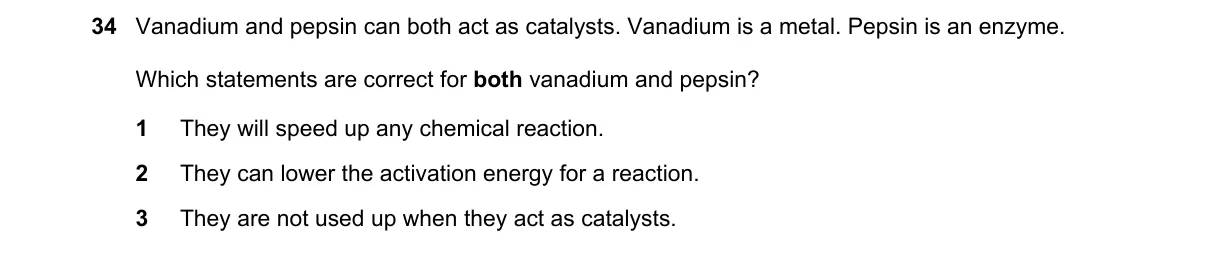
Explanation
Shared catalyst property: regeneration without consumption
Steps:
- Define catalyst as a substance that accelerates specific reactions by alternative pathways without net change to itself.
- Evaluate A against definition: false, since catalysts target specific reactions only.
- Evaluate B: enzymes lower Ea directly, but metal catalysts like vanadium primarily enable surface reactions, not universally described as lowering Ea.
- Evaluate C: matches core definition for all catalysts, inorganic or biological.
Why C is correct:
- Catalysts, by definition, remain unchanged and are regenerated at reaction end, per standard chemical kinetics (no net consumption).
Why the others are wrong:
- A: Catalysts accelerate only specific reactions, not any chemical reaction.
- B: Lowering activation energy applies mainly to enzymes like pepsin; vanadium as a heterogeneous metal catalyst works via adsorption on its surface.
- D: Not enough information.
Final answer: C
Topic: Reaction kinetics
Practice more A Levels Chemistry (9701) questions on mMCQ.me