A Levels Chemistry (9701)•9701/11/M/J/19
Explanation
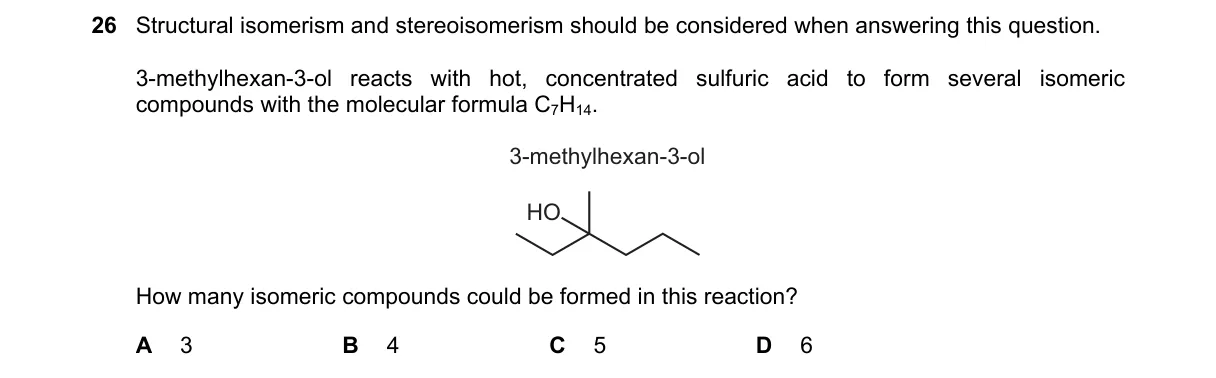
Dehydration of 3-methylhexan-3-ol forms C7H14 alkenes via E1 mechanism
Steps:
- Tertiary alcohol dehydrates to carbocation at C3: CH3CH2C+(CH3)CH2CH2CH3.
- β-hydrogens lost from C2 (CH2), C4 (CH2), or methyl on C3 (CH3).
- Loss from C2 yields 3-methylhex-2-ene with E/Z stereoisomers due to different substituents on C2 and C3.
- Loss from C4 yields 3-methylhex-3-ene with E/Z stereoisomers due to ethyl/methyl on C3 and H/ethyl on C4.
- Loss from methyl yields 3-methylidenehexane with no stereoisomers as =CH2 is symmetric.
Why C is correct:
- Exactly five isomers: two E/Z pairs (four) plus one terminal alkene, per Zaitsev's rule and stereoisomer definition for disubstituted alkenes.
Why the others are wrong:
- A: Counts only three structural isomers, ignoring E/Z stereoisomerism.
- B: Counts four, possibly two E/Z and two structures, missing the exocyclic alkene.
- D: Counts six, incorrectly assuming carbocation rearrangement adds extra products.
Final answer: C
Topic: Hydroxy compounds
Practice more A Levels Chemistry (9701) questions on mMCQ.me