A Levels Chemistry (9701)•9701/11/M/J/19
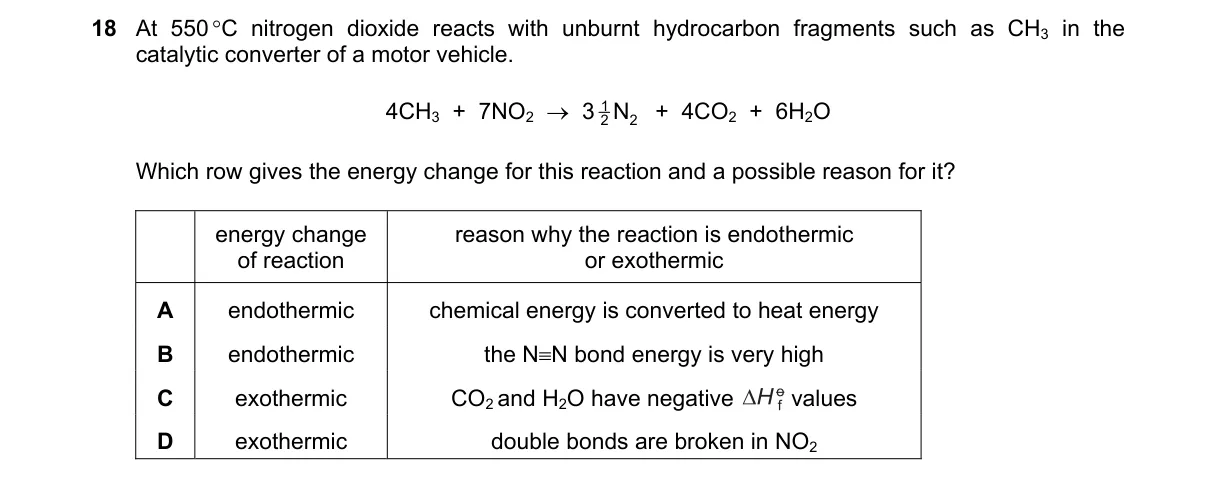
Explanation
Reaction enthalpy from standard enthalpies of formation
Steps:
- Balance the reaction conceptually for enthalpy: CH₄ + 2NO₂ → N₂ + CO₂ + 2H₂O (adjusted for stoichiometry).
- Compute ΔH_rxn = [ΔH_f(N₂) + ΔH_f(CO₂) + 2ΔH_f(H₂O)] - [ΔH_f(CH₄) + 2ΔH_f(NO₂)].
- ΔH_f values: N₂ = 0 kJ/mol, CO₂ = -394 kJ/mol, H₂O = -242 kJ/mol (negative); CH₄ = -75 kJ/mol, NO₂ = +34 kJ/mol (less negative/positive).
- Result: Σ products much more negative than reactants, so ΔH_rxn < 0 (exothermic).
Why C is correct:
- ΔH_f for CO₂ (-394 kJ/mol) and H₂O (-242 kJ/mol) are negative per Hess's law, lowering product enthalpy and yielding exothermic ΔH_rxn.
Why the others are wrong:
- A: Reaction is exothermic, not endothermic; energy conversion describes heat release, not type.
- B: Endothermic is incorrect; forming strong N≡N triple bond in N₂ releases energy, offsetting any breaking costs.
- D: Breaking N=O bonds absorbs energy, but overall bond formation (e.g., C=O, O-H) dominates for exothermic result.
Final answer: C
Topic: Chemical energetics
Practice more A Levels Chemistry (9701) questions on mMCQ.me