A Levels Chemistry (9701)•9701/11/M/J/19
Explanation
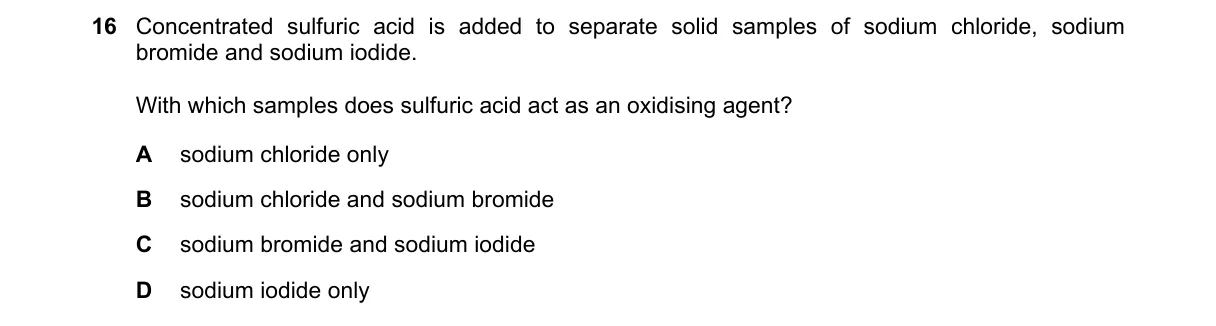
Sulfuric acid oxidizes bromide and iodide but not chloride
Steps:
- Concentrated H₂SO₄ reacts with NaCl to form HCl gas without oxidation, as Cl⁻ is not easily oxidized.
- With NaBr, H₂SO₄ oxidizes Br⁻ to Br₂ (via SO₄²⁻ + 2Br⁻ → SO₄²⁻ + Br₂ + 2e⁻), producing reddish-brown fumes.
- With NaI, H₂SO₄ oxidizes I⁻ to I₂ (via SO₄²⁻ + 2I⁻ → SO₄²⁻ + I₂ + 2e⁻), forming violet vapors.
- Oxidation occurs only for Br⁻ and I⁻ due to their lower reduction potentials compared to Cl⁻.
Why C is correct:
- H₂SO₄ acts as an oxidizing agent with NaBr and NaI because the standard reduction potential of SO₄²⁻/SO₂ (0.17 V) is sufficient to oxidize Br⁻ (-1.07 V) and I⁻ (-0.54 V), but not Cl⁻ (-1.36 V).
Why the others are wrong:
- A: H₂SO₄ does not oxidize Cl⁻, only displaces it as HCl.
- B: Includes NaCl, which undergoes no oxidation.
- D: Excludes NaBr, which is oxidized to Br₂.
Final answer: C
Topic: Group 17
Practice more A Levels Chemistry (9701) questions on mMCQ.me