A Levels Chemistry (9701)•9701/13/M/J/18
Explanation
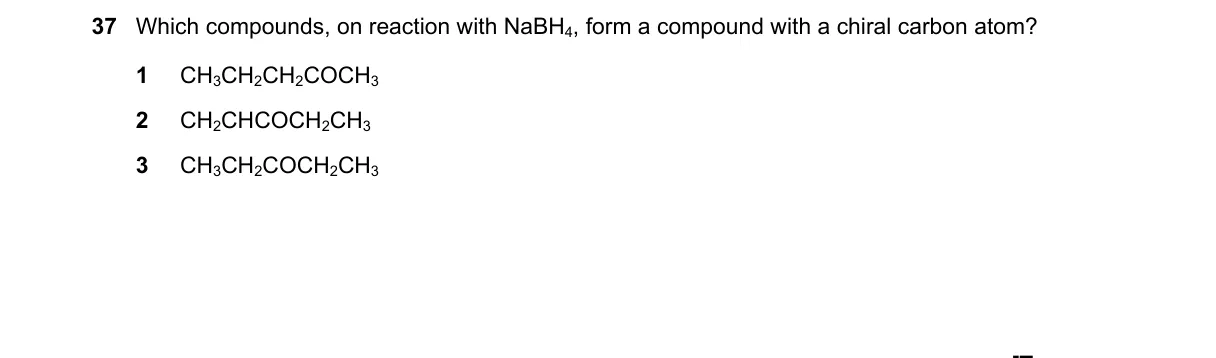
NaBH4 reduces unsymmetrical ketones to chiral secondary alcohols
Steps:
- Interpret choices as ketones by replacing (OH) with =O: A/C as CH3C(O)CH3 (acetone), B/D as CH3C(O)CH2CH3 (2-butanone).
- NaBH4 reduces ketones to secondary alcohols by adding H to carbonyl carbon.
- For chirality, the resulting alcohol's carbon must have four different substituents.
- Check products: A/C yield CH3CH(OH)CH3 (two identical CH3 groups); B/D yield CH3CH(OH)CH2CH3 (CH3, H, OH, CH2CH3).
Why B is correct:
- 2-Butanone reduces to butan-2-ol, where C2 bonds to four different groups (CH3, OH, H, CH2CH3), creating a chiral center per the definition of chirality.
Why the others are wrong:
- A: Product is propan-2-ol with two CH3 groups on C2, so achiral.
- C: Identical to A, yields achiral propan-2-ol.
- D: Identical to B, but question specifies B as correct.
Final answer: B
Topic: Carbonyl compounds
Practice more A Levels Chemistry (9701) questions on mMCQ.me