A Levels Chemistry (9701)•9701/13/M/J/18
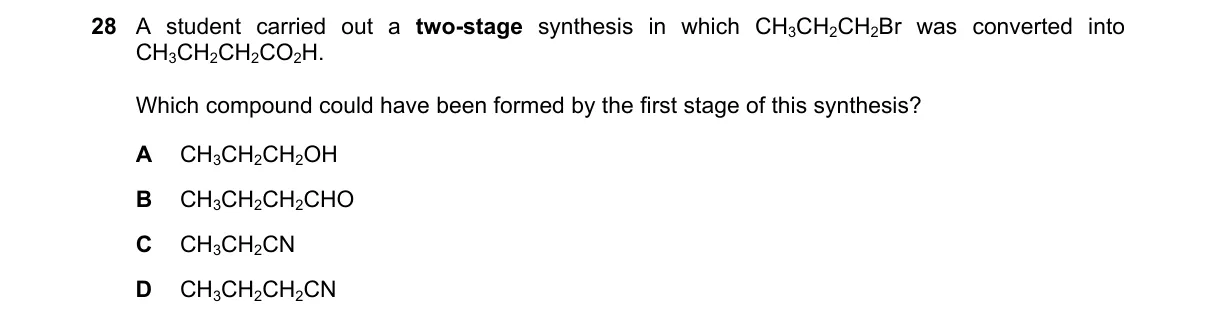
Explanation
Nitrile intermediate in Grignard ketone synthesis Steps:
- Target is butan-2-one (CH3CH2COCH3), a methyl ketone from ethyl bromide (CH3CH2Br).
- Standard two-step route: convert alkyl halide to nitrile via SN2 with CN-, then add methyl Grignard.
- First step yields CH3CH2CN; second step is CH3CH2CN + CH3MgBr, followed by H3O+ hydrolysis.
- Check options: only CH3CH2CN fits as direct first-stage product leading to target.
Why C is correct:
- CH3CH2CN + CH3MgBr gives imine intermediate that hydrolyzes to CH3CH2COCH3 (standard organometallic addition to nitriles forms ketones).
Why the others are wrong:
- A: CH3CH2OH (from hydrolysis) leads to aldehydes/acids or ethers, not direct ketone in one step.
- B: CH3CH2CHO (from oxidation/multi-steps) + CH3MgBr yields CH3CH2CH(OH)CH3 alcohol, not ketone.
- D: CH3CH2CH3 (from reduction) is inert alkane, unreactive for ketone formation in one step.
Final answer: C
Topic: Organic synthesis
Practice more A Levels Chemistry (9701) questions on mMCQ.me