A Levels Chemistry (9701)•9701/12/M/J/18
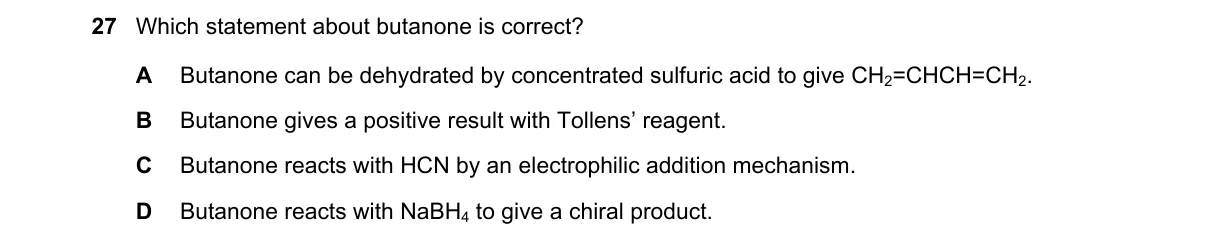
Explanation
Key properties and reactions of butanone (CH3COCH2CH3)
Steps:
- Recall butanone structure: unsymmetrical ketone with carbonyl between C1 (methyl) and C3 (ethyl).
- Evaluate A: dehydration applies to alcohols, not ketones; no alkene product like propene forms.
- Evaluate B: Tollens' reagent tests aldehydes via oxidation; ketones inert.
- Evaluate C: HCN adds to carbonyl via nucleophilic attack by CN-, not electrophilic.
- Evaluate D: NaBH4 reduces ketone to secondary alcohol butan-2-ol, with chiral carbon at C2.
Why D is correct:
- NaBH4 reduces ketones to secondary alcohols; butan-2-ol (CH3CH(OH)CH2CH3) has a chiral center at the carbon bearing OH, as it bonds to four different groups (H, OH, CH3, CH2CH3).
Why the others are wrong:
- A: Ketones resist dehydration; concentrated H2SO4 does not yield CH3CH=CH2 (propene) from butanone.
- B: Butanone lacks aldehydic H, so no mirror formation with Tollens' reagent.
- C: Carbonyl carbon is electrophile, but HCN reaction proceeds by nucleophilic addition of CN- to C=O.
Final answer: D
Topic: Carbonyl compounds
Practice more A Levels Chemistry (9701) questions on mMCQ.me